Tuesday, May 1, 2018

Narada Bhakti Sutra - Post 85


Sutra 81. Trisatyasya bhaktireva gareeyasee bhaktireva gareeyasee.

[Only love of the absolute, eternal truth is the greatest ; this love indeed, is the greatest.]

Trisatyasya: of the absolute, eternal truth
Bhakti: devotion
eva: alone
Gareeyasi: is greater
Bhakti: devotion
eva: only
Gareeyasee: is greater.

As per Devarishi Narada, in all the three periods of time, i.e. past, present, and future, devotion alone weighs heaviest (most glorious), devotion alone weighs heaviest (most glorious).

Of the three true paths, the path of devotion is greater than anything else; it is greater than anything else.

In this Sutra, Narada emphasized the value and importance of devotion. Divine love is eternal.

Repetition of the word “Gareeyasee” adds force. It glorifies devotion to the highest degree.
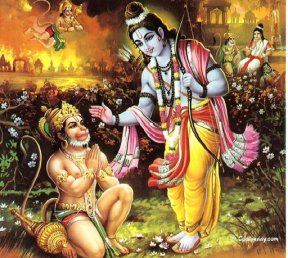
Bhakti alone is preferable to other paths, Bhakti alone is preferable.

The path of devotion is the highest path. Love of God is supreme. Devotion to God is devotion to Eternal Truth.


Trisatyam: The three eternal truths are 

(1) Jnana, 
(2) Karma and 
(3) Bhakti. 

God is love, goodness and truth. 

God is experienced by the devotee as love. 

God is experienced by the Karma Yogin as goodness. 

God is experienced by the Gyani as Truth. 

Narada says that the first is better than any other.
  
In the 12th chapter of Gita, Lord Krishna says, “The devotee is Yukta Tama” the best and highest among those who are united to Him.

“Among all Yogis, he who, full of faith, with his inner Self merged in Me, worships me, he is deemed by Me to be the most divine.” Gita, VI. 47. Thus the Bhakta is given the highest place.


Para Bhakti and Jnana are one. Para Bhakti is superior to Mukhya Bhakti even. 

In Para Bhakti, the devotee is one with his higher Self. The object of his love now is not the Personal God but the Absolute. 

The devotee now passes beyond time, space and causation, beyond the three Gunas, beyond the three states of waking, dream and deep sleep, even beyond the Triputi or subject-object relationship. He realises his oneness with the Lord.

Dear All,

As shared with you all, Swami put this author in the path of Bhakti in this birth from the age of 11 and held the devotee's hands and carried him in this noble path till he reached 47 years in his age in this birth.

In between, along with the path of Bhakti, Swami put him in service, made him zonal service coordinator in a zone in Delhi, made him take up an entire slum, get into service full time.

The path saw many ups and downs, he went through the roller coaster in life, attaching to Lord many a times and missing the Lord some times. 

In his 47th age, Swami willed and put him in the path of Jnana, about which he had no prior experience, though, he could pick up some portion from the Bhagwad Gita etc. and could give a decent talk.

But when he was put on the path of Jnana, there was no looking back and the next 6 months saw him reading and assimilating the main treatise in Jnana, the Upanishads and the related  treaties of Sankara, Sivananda, Chinmayananda, Krishnananda, Paramahamsa yogananda, Dattatreya and many more!!!

So, as a devotee and a sadhaka who has gone through all the three paths, not as a generalist but with intensity, with Swami's grace, the author can only say the following, out of his own life's experience, on this sutra.

"Even in Service / Path of Karma, in Wisdom, the path of Jnana, Dosage of Bhakti is very important and it adds strength and purpose in the other 2 paths.

Without Love for God, perhaps, all the author's learning in the path of Jnana might not have borne fruit to the extent it did, due to the fact that much of his past years saw him immersed in the path of devotion, singing Lord's glory from his childhood, again with Sai's grace.

Without Love, there is a string possibility that all the learning in Jnana might have been just a theoretical learning, adding knowledge to the head and adding more EGO to the strong head with more knowledge thrust into it.

Without Love, ritualistic Bhakti, his visits to Parthi, his bhajan singing etc. would have also become a routine, ritualistic. 

Thus, it is not only to say that only Bhakti is the greatest path, but out of author's own direct experience, he can say truthfully that it is devotion which helps, which adds fragrance to all the other path in spirituality too.

It is as though, pleased with his devotion only that the lord Himself chose to put him in the path of Jnana, otherwise, how and why one would  take up the difficult path of upanishads, meditating on TRUTH which has no form as such, after his 45 years of drinking the nectarine form of Sathya Sai.

So, Lord Himself takes care and decides the future of a devotee in his spiritual path, if the devotee submits himself to the Lord in pure love.

Love.


Monday, April 30, 2018

Narada Bhakti Sutra - Post 84

Sutra 80. Sa keertyamaanah seeghramevaavirbha- vatyanubhaavayati bhaktaan.

[Being thus invoked or glorified. He (the Lord) manifests Himself, and blesses His devotees with realization.]

Sa: Me
Keertyjimaanah: being invoked, being glorified
seeghram: speedily
eva: surely
aavirbhavati Bhaktaan: reveals himself (to the) devotees
anubhavayati: makes realize.

Lord Hari came out of the pillar in the form of Narasimha when Prahlada prayed with his full heart, Prahlada said to his father: “My Narayan is in your heart. He is in my heart. He is in this straw. He is in this pillar also”.

Prahlada pointed out four places. But why did Lord Narayan come out of the pillar?

Because Prahlada had his full concentration with full feeling, “Sarva-bhavena”, in the pillar alone. He wished the Lord Hari should come out of the pillar. This was his sat-sankalpa.

When one worships the Lord, invoking Him with our whole personality, our mind is turned towards the Higher, through our earnest identification with His glories, the TRUTH (GOD) within unveils itself and reveals itself.

The Lord then, out of His compassion, makes the devotee experience HIM.

He indeed reveals Himself

We find proof of this in our Puranas. Dhruva stands on one leg doing tapas. Sree Narayana comes and stands in front of him but Dhruva refuses to open his eyes.

The Lord blows His conch and tells Dhruva, “I have come”.

Still, Dhruva refuses to open His eyes and says, “Many times, You have come and when I have opened my eyes, You have deceived me and I am distracting to something else. O Lord, Though art within and without. So, You Yourself come within and reveal Yourself in my very heart”.

It is said that a saint named Saint Teresa existed in west once upon a time and once she sees a vision of Jesus and in that vision, Jesus asks her, “Who are you”. The Saint replies, “I am Teresa of Jesus”.

Jesus replies and says, “I am Jesus of Teresa”!! This is what God does to a sincere devotee!!!

That is how Lord reveals Himself to those who seek Him sincerely.

Love.


Sunday, April 29, 2018

Narada Bhakti Sutra - Post 83


Sutra 79. Sarvadaa Sarvabhaavena Nischintaih Bhagavaaneva bhajaneeya.

[The Lord alone should always be worshipped by one whole-heartedly free from all cares and anxieties.]

Sarvadaa: always
Sarva Bhaavena: with the whole heart, through every aspect of life
Nischintaih: by those free from all cares and anxieties
Bhagavaan eva:  the Lord alone
Bhajaneeya: should be worshipped.

Chinta means ‘thinking’, ‘reflecting’, ‘being anxious about’.

Sarvabhaavena: Bhaava is mode of existence; in all their modes of existence, and in all their moods. In every aspect of life, the devotee must have only God-consciousness. In his attitude to the members of his family, to his friends who do good to him, to those who do evil, to his superiors and to his inferiors, in every relation that subsists between him and others he has only God-consciousness.

Bhagavan: He who has all glory, all power and all wisdom, i.e., the Lord.

Bhajanam: worshipping. ‘Bhaj’ literally means to ‘share in’ to obtain for oneself, to partake of. Bhakta is one who shares all the glory, power and knowledge with the Lord.

To share also means that a true Bhakta is the one who gives, who shares, who does any thing and everything for the God and the God alone. Thus, all our thoughts, words and actions must hence forth be aligned only and only with the God.

‘Nischinta Bhajana’ is complete concentration of the mind on God without a break at any time.

Dear Bhaktas,

Let us get a little more deeper to the most powerful expressions given in in thus sutra.

Sarvadaa: always
Sarva Bhaavena: with the whole heart, through every aspect of life
Nischintaih: by those free from all cares and anxieties
Bhagavaan eva:  the Lord alone

In the path of Jnana, there are these 4 pre-requisite qualifications such as Viveka, Vairagya, Shad Sampath and Mumukshatva.

With all these qualifications acquired, a proper Guru sought and intense meditation and absorption undertaken, when the God comes to such a sadhaka (Coming of God here means, the sadhaka getting the experience of SELF / Atman which is the core of Jnana path), the God comes like a King for whom you have to clean up your entire house (cleaning here means, you have made all the preparations of 4 qualifications, sravanam, mananam, nidhidhyasanam etc.). So, the God, like KING, JUST COMES AND OCCUPIES YOUR HOME (HEART).

Whereas, in the path of Bhakti, the God comes like a maid servant in the sense that you have to only invite the lord and He Himself comes and undertakes the ordeal of cleaning your home (cleansing of all your impurities within your heart), decorate your heart (with purity) and makes your home pure and perfect!!!!

We have, in our  life,  so many wants, so many desires. We say, "I want a good wife, I want a good education, good career, good bank balance, good power, good name, good fame, good pleasures etc..So, we want, want and want!!!!"

In the path of Jnana, you have to really go inward to annihilate all these passions by exercising dispassion, detachment etc.

In the bhaki, what we have to do???

Talking of Sarvabhavena mentioned in this Sutra, when a devotee went  and submitted to Sri Rama Krishna and said, “Thakur ji, I have lots of lust, I just don’t know how to overcome this lust, greed, desires”, to which, Sri Rama Krishna asks back- “Who asked you to get rid of all your desires, all your greed??”

The devotee who is shocked to receive such an answer, Sri Ramakrishna clarifies and says, "Just do one thing, divert all those desires, all that greed, all your wants intensely to GOD, rest, God will take care".

When and only when we are able to follow this simple practice, then like the maid servant example explained before, the God Himself will work through us and all the dispassion, detachment etc. will automatically happen. 

No meditation, no nidhidhyasana, no intense practice of vairagya etc., Just Love God. God will occupy your heart in such a way that there is no scope, no room, no chance of any passion, attachment, greed, lust any more for the external objects. It is all then Love, Love and only Love for and Love of God.


So, the actual problem is not our restlessness, our ignorance, our desire, our sufferings, our pain, our ego etc.


THE ACTUAL PROBLEM IS THAT WE DO NOT LOVE GOD WHOLLY, AS EXPLAINED IN THIS SUTRA WHICH SAYS,

THE LORD ALONE SHOULD ALWAYS BE WORSHIPPED BY ONE, WHOLE-HEARTEDLY, FREE FROM ALL CARES AND ANXIETIES”.

Love.