Thursday, May 3, 2018

Narada Bhakti Sutra - Post 86


Sutra 82. Gunamaahaatmyaasaktiroopaa sakti poojaa sakti smaranaa sakti daasyaa sakti sakhyaa sakti vaatsalyaa sakti kaantaa sakti aatmanivedanaa sakti tanmayaa sakti paramavirahaa sakti roopaikadhaapyekaadasadha bhavati.

[Bhakti, or Divine Love, though in itself one only, manifests itself in the following eleven forms:
(1) Love of the glorification of the Lord’s blessed qualities,
(2) Love of his enchanting beauty,
(3) Love of worship,
(4) Love of constant remembrance,
(5) Love of service,
(6) Love of Him as a friend, 
(7) Love of Him as a son,
(8) Love for Him as that of a wife for her husband,
(9) Love of self-surrender to Him,
(10) Love of complete absorption in Him,
(11) Love of the pain of separation from Him.]

Ekadha: of one way, of one kind
Api: Even
Gunamaahatmyaasakti: love for glorifying the divine attributes
Roopaasakti: love of divine beauty
Poojasakti: love of worship
smaranaasakti: love of remembering
Daasyaa-sakti: love of service
Sakhyaasakti: Love of God as a friend
Vaatsalyasakti: love of God as that of a child
Kaantaasakti: Love of God as that of a wife
Aatmanivedanaasakti: love of self-surrender
Tanmayaasakti: love of complete absorption in Him
Paramavirahaasakti: love of the pain of separation from Him
Rupa: in the form
Ekaadasadha: of eleven forms
Bhavati: becomes.

First of all, the devotee serves the Lord as a servant serves his Master. Then he approaches Him nearer and behaves towards Him as a friend does towards a friend. The relationship is then felt to be more closely personal. 


Therefore, the devotee rises higher and manifests parental affection for the loved one, as a father to his son. Lastly the little remaining remoteness between them disappears altogether. The two become one in spirit. 

The devotee develops all the marks of a beloved wife’s love for her beloved husband. In Atmanivedan or complete self-surrender, there is complete self-absorption. 

He feels the Living presence of God anywhere and everywhere and permanently loses himself in the Lord.

You can know you love the Lord when you feel you cannot live without Him.

The purpose of the life of a devotee is to lose all sense of distinctive personality and be dissolved in the Lord like camphor in the fire.

Narada and Vyasa, Sukadeva, Kakabhusundi, Sesha, Suta, Saunaka, Sandilya, Bhishma, Prithu, Parikshit and Janamejaya delighted themselves in singing the glories of the Lord.

The Gopis of Brindavan, the Rishis of Dandakaranya were naturally attracted by Sri Krishna's enchanting personal beauty.

Ambarisha, Lakshmi, Prithu, Bharata spent whole time in worship.

Prahlada, Dhruva, Sanaka in remembrance.

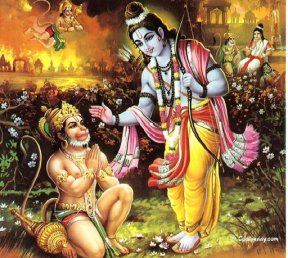
Hanuman, Akrura, Vidura in service.

Uddhava, Arjuna.. Sudama and Guha had the attribute of friendship.

Sridama, Rukmini and Satyabhama loved Sri Krishna as a husband and

Dasaratha, Kausalya, Devaki, Nanda, Yasoda, Kasyapa, Aditi, Manusatarupa, as their son. 

Bali, Vibhishana, Hanuman, Ambarisha, Sibi did complete self-surrender to the Lord.

Sanatkumar, Suka, Sanaka and Yajnavalkya immersed themselves in His Bliss (Tanmayasakti).

Uddhava, Arjuna, Gopis and Radha experienced anguish of separation. Each one is characterised by a predominant attitude. All these eleven forms of Bhakti are possible for the same Bhaktas during different moods.

Viraha is the highest manifestation of love. It is a common characteristic of all devotees, because it is in the very nature of intense love that it cannot bear separation. This is one of the supreme tests of devotion in Sutra 29. This stage of love is typically manifested in Radha and the Gopis when they were separated from Sri Krishna.

If all these forms of attachments cannot be developed together, you can select one or two sentiments and cultivate love for God accordingly. Love is fundamentally one. Therefore, no distinction of higher and lower should be made among devotees, according to the difference of sentiment cultivated by them.


All these eleven types of divine love were found developed among the Gopis.


Continued...........


Tuesday, May 1, 2018

Narada Bhakti Sutra - Post 85


Sutra 81. Trisatyasya bhaktireva gareeyasee bhaktireva gareeyasee.

[Only love of the absolute, eternal truth is the greatest ; this love indeed, is the greatest.]

Trisatyasya: of the absolute, eternal truth
Bhakti: devotion
eva: alone
Gareeyasi: is greater
Bhakti: devotion
eva: only
Gareeyasee: is greater.

As per Devarishi Narada, in all the three periods of time, i.e. past, present, and future, devotion alone weighs heaviest (most glorious), devotion alone weighs heaviest (most glorious).

Of the three true paths, the path of devotion is greater than anything else; it is greater than anything else.

In this Sutra, Narada emphasized the value and importance of devotion. Divine love is eternal.

Repetition of the word “Gareeyasee” adds force. It glorifies devotion to the highest degree.

Bhakti alone is preferable to other paths, Bhakti alone is preferable.

The path of devotion is the highest path. Love of God is supreme. Devotion to God is devotion to Eternal Truth.


Trisatyam: The three eternal truths are 

(1) Jnana, 
(2) Karma and 
(3) Bhakti. 

God is love, goodness and truth. 

God is experienced by the devotee as love. 

God is experienced by the Karma Yogin as goodness. 

God is experienced by the Gyani as Truth. 

Narada says that the first is better than any other.
  
In the 12th chapter of Gita, Lord Krishna says, “The devotee is Yukta Tama” the best and highest among those who are united to Him.

“Among all Yogis, he who, full of faith, with his inner Self merged in Me, worships me, he is deemed by Me to be the most divine.” Gita, VI. 47. Thus the Bhakta is given the highest place.


Para Bhakti and Jnana are one. Para Bhakti is superior to Mukhya Bhakti even. 

In Para Bhakti, the devotee is one with his higher Self. The object of his love now is not the Personal God but the Absolute. 

The devotee now passes beyond time, space and causation, beyond the three Gunas, beyond the three states of waking, dream and deep sleep, even beyond the Triputi or subject-object relationship. He realises his oneness with the Lord.

Dear All,

As shared with you all, Swami put this author in the path of Bhakti in this birth from the age of 11 and held the devotee's hands and carried him in this noble path till he reached 47 years in his age in this birth.

In between, along with the path of Bhakti, Swami put him in service, made him zonal service coordinator in a zone in Delhi, made him take up an entire slum, get into service full time.

The path saw many ups and downs, he went through the roller coaster in life, attaching to Lord many a times and missing the Lord some times. 

In his 47th age, Swami willed and put him in the path of Jnana, about which he had no prior experience, though, he could pick up some portion from the Bhagwad Gita etc. and could give a decent talk.

But when he was put on the path of Jnana, there was no looking back and the next 6 months saw him reading and assimilating the main treatise in Jnana, the Upanishads and the related  treaties of Sankara, Sivananda, Chinmayananda, Krishnananda, Paramahamsa yogananda, Dattatreya and many more!!!

So, as a devotee and a sadhaka who has gone through all the three paths, not as a generalist but with intensity, with Swami's grace, the author can only say the following, out of his own life's experience, on this sutra.

"Even in Service / Path of Karma, in Wisdom, the path of Jnana, Dosage of Bhakti is very important and it adds strength and purpose in the other 2 paths.

Without Love for God, perhaps, all the author's learning in the path of Jnana might not have borne fruit to the extent it did, due to the fact that much of his past years saw him immersed in the path of devotion, singing Lord's glory from his childhood, again with Sai's grace.

Without Love, there is a string possibility that all the learning in Jnana might have been just a theoretical learning, adding knowledge to the head and adding more EGO to the strong head with more knowledge thrust into it.

Without Love, ritualistic Bhakti, his visits to Parthi, his bhajan singing etc. would have also become a routine, ritualistic. 

Thus, it is not only to say that only Bhakti is the greatest path, but out of author's own direct experience, he can say truthfully that it is devotion which helps, which adds fragrance to all the other path in spirituality too.

It is as though, pleased with his devotion only that the lord Himself chose to put him in the path of Jnana, otherwise, how and why one would  take up the difficult path of upanishads, meditating on TRUTH which has no form as such, after his 45 years of drinking the nectarine form of Sathya Sai.

So, Lord Himself takes care and decides the future of a devotee in his spiritual path, if the devotee submits himself to the Lord in pure love.

Love.