Tuesday, June 16, 2020

Bhagwad Gita - Post 233


Verse 37

That which is like poison at first but in the end like nectar—that pleasure is declared to be Sattwic, born of the purity of one’s own mind due to Self-realisation.


True happiness comes through serenity, equipoise and equanimity which is the treasure of Sattvic persons.


The Sattvic path, however, is not an easy one to follow and the difficulties are many, especially in the early stages. 


The experience is bitter in the beginning but in the end, it is nectarine.


Why the Lord says so??


When a human being moves from Rajasic to Sattvic tendencies and takes up sadhana for attaining Self Realization, it calls for a total shift in his priorities, total shift in approach to life, renunciation of desires and comforts and a life of a Sadhu with nothing to be thought as his own (Internal state is described here, though externally things may or may not change at all for him).


This paradigm shift in approach to life seems to be so difficult that the Lord describes the same to be as though one has to take poison.


But what is the ultimate end to the intense sadhana that a sattvic person takes up??


Having  renounced the entire world, when one attains Self- realization, he experiences the entire creation to be his own, he attains perfect union with SELF and experiences the entire creation as nothing but the same SELF.


This is the nectarine experience that the Lord indicates in this verse. 


Verse 38


That pleasure which arises from the contact of the sense-organs with the objects, which is at first like nectar and in the end like poison—that is declared to be Rajasic.


If the previous verse’s exposition is understood clearly, then it is easy to understand the purport of this verse.


All material pleasures arising out of contact of our sense organs with the object which we perceive to be having the propensity to fill us with pleasure and happiness, does give us a good experience at sense level  in the beginning, but the continuous search, continuous pursuit of such pleasure pushes a rajasic person to samsara and he gets bound by samsara


His condition is like a man who is supposed to be free but is bound by chain (of samsara).

Thus, what seemed to be pleasure in the beginning, ends up like the experience of consuming poison at the end.


In the Brihadaranyaka Upanishad, when Yagnavalkya decides to relinquish his wealth by distributing the same amongst his wives, one of the wives asks a question to him, “if the wealth that he is giving to her would get her eternal freedom?”, the answer she gets is NO.


Yagnavalikya explains,


“The love that you feel in respect of an object is in fact the
love that you feel towards that which is called perfection and completeness. It is not really a love for the object. You have thoroughly misunderstood the whole point, even when you are clinging to a particular object as if it is the source of satisfaction. The mind does not want an object; it wants completeness of being. That is what it is searching for. 

Thus, when there is a promise of the fulfillment that it seeks, through the perception of an object that appears to be its counterpart, there is a sudden feeling that fullness is going to come, and there is a satisfaction even on the perception of that object; and there is an apparent satisfaction, just by the imagined possession of it together with the yearning for actual possession. So, what is it that you are asking for? You are not asking for any object or thing; you are asking for a condition of completeness in your being. 


"So, my dear friend," says Yajnavalkya, "nobody is dear. No object can be regarded as lovable or desirable. It is something else that you love and are asking for, but by a notion that is completely misconstrued, you believe that the object is loved."


And, since any such object pursued is by its very nature temporary, a Rajasic person runs from pillar to post for getting pleasures from such objects and in the process, ends up with only pain and misery, as the permanent happiness sought by him has ended leaving him high and dry.


Verse 39


That pleasure which at first and in the sequel is delusive of the self, arising from sleep, indolence and heedlessness—such a pleasure is declared to be Tamasic.


Swami Krishnananda writes,


“For instance, the happiness that one gets by drinking alcohol is tamasic happiness. It will completely delude our brain and put us into a state of stupor, giving us the false impression that we are in a state of joy. It appears to bring some kind of satisfaction to a person, but it is a deluded mind that thinks in this fashion. 

The person is happy in the beginning, in the middle and in the end—because he is drunk. In a person who is drunk, the nerves are stimulated and appear to be always in a state of happiness, but they are going to collapse completely after some time. 


Such happiness which is totally undesirable is tamasic happiness. It will lead to sorrow and sleep. A drunken man sleeps, and when he wakes up he again drinks, and after drinking again sleeps, and after sleeping again drinks on waking up. What kind of happiness is this? This is the kind of life that some people live in the world—tamasic.


Love.


Sunday, June 14, 2020

Bhagwad Gita - Post 232


Verse 33


The unwavering firmness by which, through Yoga, the functions of the mind, the life-force and the senses are restrained—that firmness, O Arjuna, is Sattwic!


Although mind has many functions such as desire and aversion, it is buddhi intellect and dhriti determination which lead to righteousness and happiness whereas their absence leads to unrighteousness and despair. 


Of the various functions of the mind, buddhi and dhriti are the chief ones that determine the others and so the influence of the three gunas or modes of material nature have been specifically explained in this light by Lord Krishna.


The threefold influence of the three gunas or modes of material nature beginning with sattva guna mode of goodness on dhrita or determination is illustrated by unwavering concentration upon the goal to be achieved by the aid of yoga or the individual consciousness attaining communion with the ultimate consciousness by meditation and yoga by which the senses are brought under complete control and directed to focus fully upon the goal. Such dhrita possessed by a jiva or embodied being is situated in sattva guna.


Verse 34


But that firmness, O Arjuna, by which, on account of attachment and desire for reward, one holds fast to Dharma, enjoyment of pleasures and earning of wealth—that firmness, O Arjuna, is Rajasic!


Amongst the four purushartha, Dharma denotes the righteous way of living while pursuing anything whatsoever in life, in the personal, domestic or societal front. Devoid of dharma, human life is bound to degenerate woefully, and miss the goal of fulfillment.


In order to live in the world, we need many materials and facilities. To avail of these, requisite resources are called for. Artha refers to wealth and other resources, which are necessary to fulfill our material needs.


While proceeding to acquire wealth by means of regular efforts, it is important that one conforms to the dictates of dharma, righteousness. All the restraints and disciplines that righteousness enjoins have to be adhered to with care and caution. Only then, with the wealth thus acquired, one is free to fulfill his personal and familial desires (kama).


In desiring and also in gaining the desired object, one has to be fair and moderate. No hurt or harm should be caused to another in the haste or hurry of pursuing one’s needs. “Live and let live” should be the constant watchword. The blending of individual life with the welfare of the society as well as Nature is an indispensable demand of dharma.


Even when dharma, artha and kāma are gained in ample measure, human life will not prove fully meaningful or attain its destined fulfillment. Fulfillment can only be had when the inner personality becomes clean, free and light.

That will be possible only through the art and process of discrimination. 


Sufficient introspection and evaluation have to be done about what constitutes life and how it can be led to its fullness. Moksha literally means freedom. But it is not in respect of the body or its life-breath. It is with respect to the mind and intelligence. The inner freedom is what the fourth puruārtha, moksha, represents.


Whether it is a life of propriety and piety, affluence and luxury, with creditable familial and social extensions or otherwise, one thing is certain – everything and all are ultimately to be left. All these will get distanced, despite one’s wish or will. Even the body on which rest all relationships, by and for which we acquire everything, will have to be shed one day.


To perceive this truth and give due place for it as early as possible in one’s life is the call of the fourth puruhartha, moka. The considerations and evaluation moksha instills form the very essence of all pursuits, their relevance and purpose.


But the mind given to rajasik tendencies will generally avoid this kind of a perception or evaluation, due to attachment and greed for immediate results. This delusion leads it to miss or fail to evaluate the last puruārtha. By that, the whole life becomes aimless, defective and disappointing. 


Verse 35


That by which a stupid man does not abandon sleep, fear, grief, despair and also conceit—that firmness, O Arjuna, is Tamasic!


Determination is seen in the unintelligent and ignorant too. But it is the obstinacy that arises from fear, despair, and pride. 


For instance, some people are victims of a fear-complex, and it is interesting to see how they hold on to it with great tenacity, as if it is an inseparable part of their personality. 


There are others who make their life a living hell because they cling to some past disappointment and refuse to let go of it, despite observing its ruinous impact upon them. 


Some insist upon quarreling with all who hurt their ego and its imagined conception of themselves. 


The firmness described in this verse, of beings with Tamsaic nature is by far the most dangerous / most devastating quality.


These are the human beings who have lacked self- confidence from the very beginning, leading a life of fear and inferiority complex. 


When, due to their past karma as well as due to lack of purushartha in present life, they have to undergo sufferings in the present birth, their basic lack of confidence coupled with sufferings in present birth leads to fear, despair and grief. 


They fall in love with their self-imposed fear and despair to such an extent that they never “let go” the past, never pardon those who caused them suffering, most unwilling to accept that those who caused sufferings were but instruments to cause them suffering, to clear their karma which they had accumulated in past / present birth which had to be cleared in the current birth.


These beings cannot be convinced with any amount of discourse, any extent of Love, any extent of empathy.


Sri Krishna states that determination based upon such stubborn clinging to unproductive thoughts is in the mode of ignorance.


Love. 


Friday, June 12, 2020

Bhagwad Gita - Post 231

Verse 29

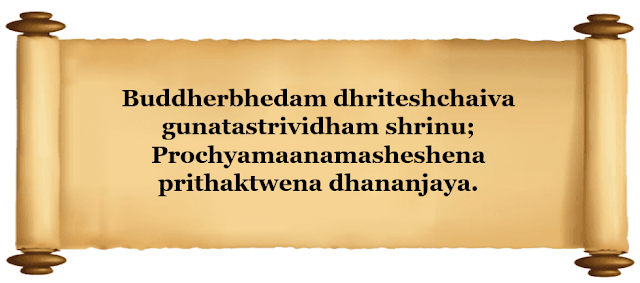
Hear thou the threefold division of the intellect and firmness according to the Gunas, as I declare them fully and distinctly, O Arjuna!


Three qualities of the intellect are mentioned here—three types of intellect, understanding. 


“Hey Arjuna, listen to the characteristics of understanding, the characteristics of determination, which I shall now touch upon briefly.”


Verse 30

That which knows the path of work and renunciation, what ought to be done and what ought not to be done, fear and fearlessness, bondage and liberation—that intellect is Sattwic, O Arjuna!


Sattvic understanding, or intellection, is that which knows what is to be done and what is not to be done under a given condition, what is proper and what is not proper. Place, time and circumstance condition the undertaking of any work to determine which work may be suitable at a particular moment and which work may not be suitable at that moment. 

That which may be fitting in this particular spot may not be suitable at another place, and that which is fitting under conditions prevailing now may not be fitting under conditions prevailing in a different manner altogether or in some other place. 


The goodness and the badness of an undertaking is not merely an ethical or a moral question. It is a philosophical and metaphysical issue based finally on the very purpose of existence itself. 


We have to decide for ourselves what criteria we will hold in judging what is proper and improper. This is a crucial question before us, and the judgment in this regard should be based, finally, on the ultimate purpose of life. That is why one has to be very intelligent in choosing any course of action. 


Such a person is sattvic who knows what is proper and what is improper, what is good and what is bad, what is to be done and what is not to be done, what is a cause of bondage and what is going to be liberating. 


Only such a person can be really intelligent, and that understanding can be regarded as sattvic in its nature: sa buddhih partha sattviki.


Verse 31

That by which one incorrectly understands Dharma and Adharma, and also what ought to be done and what ought not to be done—that intellect, O Arjuna, is Rajasic!


Here Lord Krishna explains that the buddhi or intellect of those who have erroneous conceptions of theism and atheism and do not comprehend what is righteousness and what is unrighteousness and what they entail and have no understanding of what should be done and what should not be done according to time, place and circumstance assuming wrongly what they think they know is incorrect are situated in raja guna the mode of passion.


The rājasic intellect becomes mixed due to personal attachments. At times it sees clearly, but when self-interest comes into play, it becomes tainted and confused. 


The rājasic intellect, colored by attachments and aversions, likes and dislikes is unable to discern the proper course of action. It becomes confused between the important and the trivial, the permanent and the transient, the valuable and the insignificant.


Verse 32

That which, enveloped in darkness, views Adharma as Dharma and all things perverted—that intellect, O Arjuna, is called Tamasic!


The worst kind of understanding is tamasic buddhi, which totally misconstrues all things in a topsy-turvy manner.

Totally wrong things are regarded as very good things on account of a clouding of the intellect. 


Every kind of objective in life is viewed from a selfish point of view. There is no ability to link the undertaking to the final purpose of life, because that consciousness of the final purpose is completely obliterated from a tamasic buddhi


The ‘determination’ that will be taken up for discussion in the coming verses has a connection with understanding. Intellect and will go together. The capacity of our deciding factor—decision, determination, volition—depends much, or perhaps wholly, on understanding. 


To the extent of our understanding, to that extent also we have the power of will. If the understanding is weak, the will also is weak. 


Love.