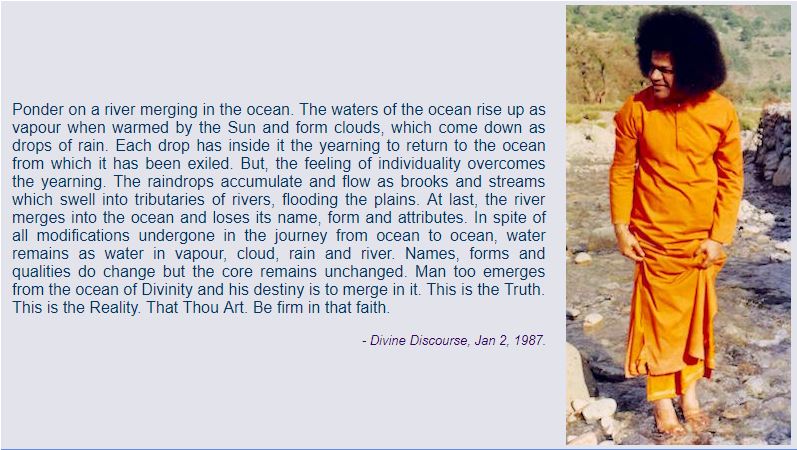
Sai pours,
"This power of super-imposition that
Maya has hides from the Jivi (or the Individual) the Universal which he is, the
Sath-Chit-Ananda which is his Nature.
All this Jagath, with its manifoldness, is born out of the ascription of
multiplicity where there is only Unity. When all this evolution is subsumed by
the process of involution (Pralaya), the three Gunas are in perfect equilibrium
or balance. This is the stage called Guna-saamya-avastha.
Then, through the Will of the Super-Will or
Iswara, the balance is disturbed and activity starts, leading to consequences
which breed further activities. In other words, the World originates and
develops and unfolds. This is the stage called Unbalanced, or Vaishamya.
Thus, from the subtle Inner unconscious and
sub-conscious to the gross outer physical body, everything is due to Maya or
the power of super-imposition of the Particular over the Universal. That is the
reason why these are referred to as Anatma, Non-Atma. They are like the mirage,
which super-imposes water over desert sand. It can be destroyed only by the
vision of Brahmam or Atma."
(Author’s note - How the three Gunas get
distributed and how the 5 elements are formed accordingly, has been
explained under “Pancheekarana” in Tattva Bodha Post no 27.)
"The affection one has towards one's
relations, the satisfaction one gets when one secures the things craved for,
the happiness one gets when one utilizes such things, all these are bondages
which the consciousness imposes on itself.
Even sleep and dream are such 'agitations'
which have to be overcome before the Atma can be well visualized and realized.
In sleep, the element of Ignorance persists. The 'I' and 'Mine' feelings
produce an endless series of activities and agitations in the various levels of
Consciousness.
But, as a single soldier in a vantage
position can successfully tackle hundreds of enemy personnel who come in single
file through a narrow gap, one has to tackle each agitation as and when it
emerges in the Consciousness and overwhelm it. The courage to do this can be
got through the training derived by practice.
All agitations will cease the moment one
enters on the inquiry, "Who am I"? This was the Sadhana that Ramana
Maharshi achieved and taught to his disciples. That is also the easiest of all
the disciplines.
First, there must be the Subhechchaa, the desire to promote one's own welfare. This will lead to the study
of treatise about Brahman and its principles, the search for the company of the
good, the withdrawal from sensory pleasure and the thirst for liberation.
Even the Mahaavaakya, "Aham
Brahmaasmi", has a trace of ignorance sticking on to it, the Aham,
considered as separate but identical. This Aham is so persistent that it will
disappear only through ceaseless meditation on the implications of
"Tatwamasi" and all-inclusive Atma or Brahmam. This is the
Vichaarana stage or Bhumika; the Bhumika, subsequent to the Subhechchaa stage.
By these means, the Mind can be fixed very
soon on the contemplation of Brahmam. Each stage is a step on the ladder for
the progressive rise of the Mind, from the concrete to the subtle and the
subtle to the non-existent. This is the Tanumanasi or the last stage."
(Author’s note - The 7 stages in the path of
Jnana - from Subhecha to Turiya, has been explained in an earlier post in the
same theme. Each previous stage matures and takes a spiritual aspirant to the
next stage.
 “Who am I?” is the title given to a set of
questions and answers bearing on Self-enquiry. The questions were put to
Bhagavan Sri Ramana Maharshi by one Sri M. Sivaprakasam Pillai about the year
1902. Few of them have been reproduced below.
“Who am I?” is the title given to a set of
questions and answers bearing on Self-enquiry. The questions were put to
Bhagavan Sri Ramana Maharshi by one Sri M. Sivaprakasam Pillai about the year
1902. Few of them have been reproduced below.
1. Who am I?
The gross body which is composed of the seven
humors (dhatus), I am not;
the five cognitive sense organs, viz. the
senses of hearing, touch, sight, taste, and smell, which apprehend their
respective objects, viz. sound, touch, color, taste, and odor, I am not;
the five cognitive sense organs, viz.
the organs of speech, locomotion, grasping, excretion, and procreation, which
have as their respective functions speaking, moving, grasping, excreting, and
enjoying, I am not;
the five vital airs, prana, etc., which
perform respectively the five functions of in-breathing, etc., I am not;
even the mind which thinks, I am not;
the nescience too, which is endowed only with
the residual impressions of objects, and in which there are no objects and no
functioning’s, I am not.
2. If I am none of these, then who am I?
After negating all of the above-mentioned as
‘not this’, ‘not this’, that Awareness which alone remains - that I am.
3. What is the nature of Awareness?
The nature of Awareness is
existence-consciousness-bliss
4. When will the realization of the Self
be gained?
When the world which is what-is-seen has been
removed, there will be realization of the Self which is the seer.
5. Will there not be realization of the
Self even while the world is there (taken as real)?
There will not be.
6. Why?
The seer and the object seen are like the
rope and the snake. Just as the knowledge of the rope which is the substrate
will not arise unless the false knowledge of the illusory serpent goes, so the
realization of the Self which is the substrate will not be gained unless the
belief that the world is real is removed.
7. When will the world which is the
object seen be removed?
When the mind, which is the cause of all
cognition’s and of all actions, becomes quiescent, the world will
disappear.)
Love.
 “Look
at the clouds that wander across the sky; note that they have no intimate
lasting relationship with the sky which they hide but for a few minutes.
“Look
at the clouds that wander across the sky; note that they have no intimate
lasting relationship with the sky which they hide but for a few minutes.
 Just
as clay takes the form of pot and pan and plate and after an interval becomes
once again clay, shapeless clay, so too, all this is the formless Sath - Chith
- Ananda;
the Niraakaara appearing with Aakaara for some time, on account of the delusion
and ignorance of the Mind.
Just
as clay takes the form of pot and pan and plate and after an interval becomes
once again clay, shapeless clay, so too, all this is the formless Sath - Chith
- Ananda;
the Niraakaara appearing with Aakaara for some time, on account of the delusion
and ignorance of the Mind.