Thursday, May 21, 2020

Bhagwad Gita - Post 220


Chapter 18

THE YOGA OF LIBERATION BY RENUNCIATION
(…continued)


Verse 65

Fix thy mind on Me, be devoted to Me, sacrifice to Me, bow down to Me. Thou shalt come even to Me; truly do I promise unto thee, (for) thou art dear to Me.


Verse 66

Abandoning all duties, take refuge in Me alone; I will liberate thee from all sins; grieve not.


Verse 67

This is never to be spoken by thee to one who is devoid of austerities, to one who is not devoted, nor to one who does not render service, nor who does not desire to listen, nor to one who cavils at Me.


Verse 68

He who with supreme devotion to Me will teach this supreme secret to My devotees, shall doubtless come to Me.


Verse 69

Nor is there any among men who does dearer service to Me, nor shall there be another on earth dearer to Me than he.


Verse 70

And he who will study this sacred dialogue of ours, by him I shall have been worshipped by the sacrifice of wisdom; such is My conviction.


Verse 71

The man also who hears this, full of faith and free from malice, he, too, liberated, shall attain to the happy worlds of those of righteous deeds.


Verse 72

Has this been heard, O Arjuna, with one-pointed mind? Has the delusion of thy ignorance been fully destroyed, O Dhananjaya?


Verse 73

Arjuna said:

Destroyed is my delusion as I have gained my memory (knowledge) through Thy Grace, O Krishna! I am firm; my doubts are gone. I will act according to Thy word.


Verse 74

Sanjaya said:

Thus have I heard this wonderful dialogue between Krishna and the high-souled Arjuna, which causes the hair to stand on end.


Verse 75

Through the Grace of Vyasa I have heard this supreme and most secret Yoga direct from Krishna, the Lord of Yoga Himself declaring it.


Verse 76

O King, remembering this wonderful and holy dialogue between Krishna and Arjuna, I rejoice again and again!


Verse 77

And remembering again and again also that most wonderful form of Hari, great is my wonder, O King! And I rejoice again and again!


Verse 78

Wherever there is Krishna, the Lord of Yoga, wherever there is Arjuna, the archer, there are prosperity, happiness, victory and firm policy; such is my conviction.


Thus in the Upanishads of the glorious Bhagavad Gita, the science of the Eternal, the scripture of Yoga, the dialogue between Sri Krishna and Arjuna, ends the eighteenth discourse entitled:

“The Yoga of Liberation by Renunciation”

Om Shanti! Shanti! Shanti!


Love.


Wednesday, May 20, 2020

Bhagwad Gita - Post 219

Chapter 18

THE YOGA OF LIBERATION BY RENUNCIATION
(…continued)


Verse 49

He whose intellect is unattached everywhere, who has subdued his self, from whom desire has fled— he by renunciation attains the supreme state of freedom from action.


Verse 50

Learn from Me in brief, O Arjuna, how he who has attained perfection reaches Brahman, that supreme state of knowledge.


Verse 51

Endowed with a pure intellect, controlling the self by firmness, relinquishing sound and other objects and abandoning both hatred and attraction,


Verse 52

Dwelling in solitude, eating but little, with speech, body and mind subdued, always engaged in concentration and meditation, taking refuge in dispassion,


Verse 53

Having abandoned egoism, strength, arrogance, anger, desire, and covetousness, free from the notion of “mine” and peaceful,—he is fit for becoming Brahman.


Verse 54

Becoming Brahman, serene in the Self, he neither grieves nor desires; the same to all beings, he attains supreme devotion unto Me.


Verse 55

By devotion he knows Me in truth, what and who I am; and knowing Me in truth, he forthwith enters into the Supreme.


Verse 56

Doing all actions always, taking refuge in Me, by My Grace he obtains the eternal, indestructible state or abode.


Verse 57

Mentally renouncing all actions in Me, having Me as the highest goal, resorting to the Yoga of discrimination do thou ever fix thy mind on Me.


Verse 58

Fixing thy mind on Me, thou shalt by My Grace overcome all obstacles; but if from egoism thou wilt not hear Me, thou shalt perish.


Verse 59

If, filled with egoism, thou thinkest: “I will not fight”, vain is this, thy resolve; Nature will compel thee.


Verse 60

O Arjuna, bound by thy own Karma (action) born of thy own nature, that which from delusion thou wishest not to do, even that thou shalt do helplessly!


Verse 61

The Lord dwells in the hearts of all beings, O Arjuna, causing all beings, by His illusive power, to revolve as if mounted on a machine!


Verse 62

Fly unto Him for refuge with all thy being, O Arjuna! By His Grace thou shalt obtain supreme peace and the eternal abode.


Verse 63

Thus has wisdom more secret than secrecy itself been declared unto thee by Me; having reflected over it fully, then act thou as thou wishest.


Verse 64

Hear thou again My supreme word, most secret of all; because thou art dearly beloved of Me, I will tell thee what is good.

Continued...

Love.


Tuesday, May 19, 2020

Bhagwad Gita - Post 218


Chapter 18

THE YOGA OF LIBERATION BY RENUNCIATION
(…continued)


Verse 33

The unwavering firmness by which, through Yoga, the functions of the mind, the life-force and the senses are restrained—that firmness, O Arjuna, is Sattwic!


Verse 34

But that firmness, O Arjuna, by which, on account of attachment and desire for reward, one holds fast to Dharma, enjoyment of pleasures and earning of wealth—that firmness, O Arjuna, is Rajasic!


Verse 35

That by which a stupid man does not abandon sleep, fear, grief, despair and also conceit—that firmness, O Arjuna, is Tamasic!


Verse 36

Now hear from Me, O Arjuna, of the threefold pleasure, in which one rejoices by practice and surely comes to the end of pain!


Verse 37

That which is like poison at first but in the end like nectar—that pleasure is declared to be Sattwic, born of the purity of one’s own mind due to Self-realisation.


Verse 38

That pleasure which arises from the contact of the sense-organs with the objects, which is at first like nectar and in the end like poison—that is declared to be Rajasic.


Verse 39

That pleasure which at first and in the sequel is delusive of the self, arising from sleep, indolence and heedlessness—such a pleasure is declared to be Tamasic.


Verse 40

There is no being on earth or again in heaven among the gods that is liberated from the three qualities born of Nature.


Verse 41

Of Brahmanas, Kshatriyas and Vaishyas, as also the Sudras, O Arjuna, the duties are distributed according to the qualities born of their own nature!


Verse 42

Serenity, self-restraint, austerity, purity, forgiveness and also uprightness, knowledge, realisation and belief in God are the duties of the Brahmanas, born of (their own) nature.


Verse 43

Prowess, splendour, firmness, dexterity and also not fleeing from battle, generosity and lordliness are the duties of Kshatriyas, born of (their own) nature.


Verse 44

Agriculture, cattle-rearing and trade are the duties of the Vaishya (merchant class), born of (their own) nature; and action consisting of service is the duty of the Sudra (servant class), born of (their own) nature.


Verse 45

Each man, devoted to his own duty, attains perfection. How he attains perfection while being engaged in his own duty, hear now.


Verse 46

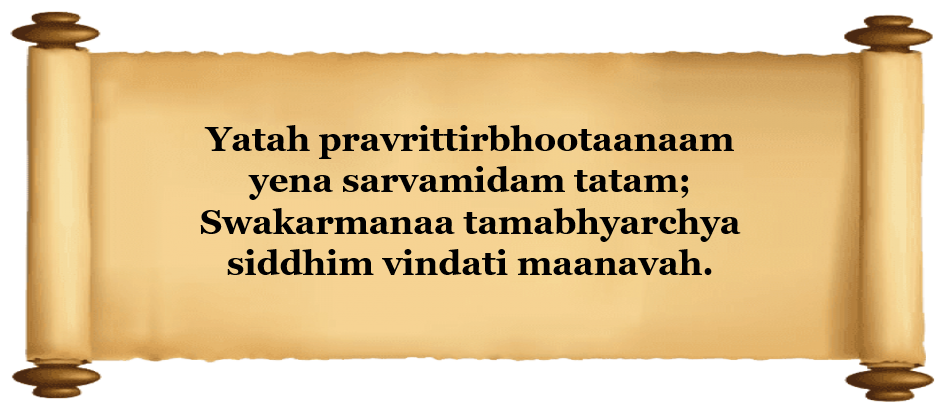
He from whom all the beings have evolved and by whom all this is pervaded, worshiping Him with his own duty, man attains perfection.


Verse 47

Better is one’s own duty (though) destitute of merits, than the duty of another well performed. He who does the duty ordained by his own nature incurs no sin.

Verse 48

One should not abandon, O Arjuna, the duty to which one is born, though faulty; for, all undertakings are enveloped by evil, as fire by smoke!

Continued...

Love.