Sunday, May 5, 2019

Bhagwad Gita - Post 19


Verse 12


Na twevaaham jaatu naasam
na twam neme janaadhipaah;
Na chaiva na bhavishyaamah
sarve vayam atah param.


Nor at any time indeed was I not,
nor these rulers of men,
nor verily shall we ever cease to be hereafter.


In the Katha Upanishad, Lord of death, Yama, teaches nachiketa, thus:-
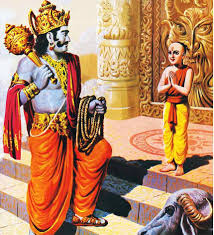

“This Self is never born, nor does It die. It did not spring from anything, nor did anything spring from It. This Ancient One is unborn, eternal, everlasting. It is not slain even though the body is slain. 


If the slayer thinks that he slays, or if the slain thinks that he is slain, both of these know not. For It neither slays nor is It slain.”


In the Skanda Purana it is stated:


"There is no possibility of any destruction of the absolute Consciousness of the Supreme Lord the same, similarly it also applies to the individual consciousness of all living entities. 


The One who so desiring manifests as the many. The connection and disconnection from the physical body is known as birth and death. Such is this reality for all living entities; but for the eternal and transcendental Supreme Lord this reality has no relevance and is in no way applicable."

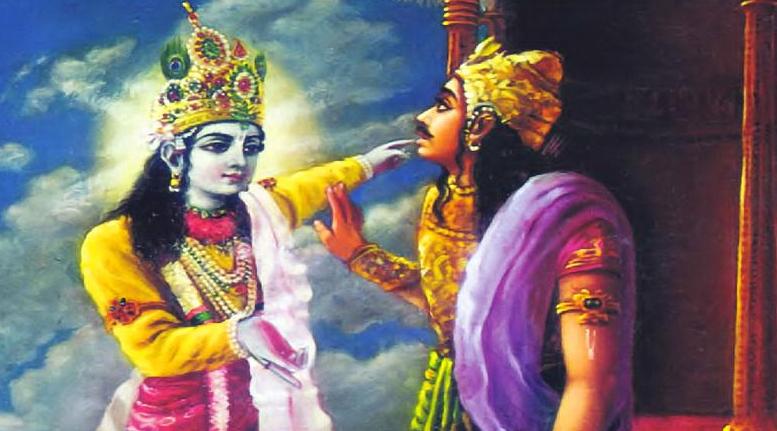
Thus, Krishna says that neither He Himself nor Arjuna nor the great kings of the age that have assembled in both the armies, are mere accidental happenings. 

They do not come from nowhere and, at their death, do not become mere non-existent. 

Dear all,

How to understand the essence of this verse in an easier manner?

We are clear from the pure canvass pour that the pure canvass = God or Brahman who / that existed even before time space, 5 elements emerged. 

And, in the same pour, we also learnt that while we are born, we occupy a part of the pure canvass and if we erase our body that has occupied the part of the pure canvass, then we are nothing else but the (part) in the pure canvass itself.

For a quick recap, please go through this pure canvass post link from an earlier blog theme post.
 

Thus, are we not clear now that the pure canvass (Krishna referring to Himself in this verse) and we (the rulers referred in the verse) are never born and shall never cease to exist?

There are two things in the world, the soul which is real and the body which is unreal. Both of these are not to be grieved for because the soul never ceases to be, and the body is ever perishable. 

Thus, Sri Krishna speaks here of the immortality of the Self or the soul. The Self exists in the three periods of time - past, present and future.


He declares that the embodied soul in everyone identifies itself with varied forms temporarily to gain preordained experiences. 

Neither Krishna himself nor Arjuna nor the other kings who have assembled in the battlefield are mere accidental happenings nor shall they cease to exist in future. It is not that they came from nowhere nor at their death they become nothing or non-existent. The soul remaining the same, it gets apparently conditioned by different body equipments and comes to live through its self-ordained environments.


The essence of this verse, "the eternal existence of SELF" has been explained with so many illustrations in Atma Bodha theme posts such as,


- Pot Space (Where the Body is like pot which may exist or which may get broken (die) whereas the space inside is neither born, bore dies). 


- Gold and Ornament (The ornament is like various bodies whose shape, color, appearance etc may vary whereas the essence, the Gold (SELF) is the same).

In fact, the Atma bodha verses theme posts are more than sufficient for reading and contemplating in one's entire life, on the IMPERISHABLE SELF, which is the essence of today's post verse.

Lord Krishna informs Arjuna that due to fraternal feelings he was neglecting his own nature not to fulfill his duty according to righteousness. Is it because of the fear of losing his life or is it because of ignorance that he (Arjuna) and all others are but Pure consciousness?

The physical body is in all respects subject to destruction so there is no purpose in being frightened, nor should there be any concern over the possibility of destruction of the individual consciousness because its nature is also eternal.

Love.


Friday, May 3, 2019

Bhagwad Gita - Post 18

Dear All,


After allowing Arjuna to speak out and express his deluded state fully, the Lord takes over only after Arjuna is through with all his expressions, all his logics and is now looking for the guidance from Hrishikesa (Hrisika+Isa = Lord of senses).


Chapter 2 - Verse 11

Ashochyaan anvashochastwam
prajnaavaadaamshcha bhaashase;
Gataasoon agataasoomshcha na
anushochanti panditaah.


The Blessed Lord said:

You have grieved for those that should not be grieved for, yet you speak words of wisdom. The wise grieve neither for the living nor for the dead.

Sri Krishna directly takes Arjuna to the highest realm of Truth, the essence of all Upanishads by pointing out that it is unwise on the part of Arjuna to grieve for the death he foresees of the army of Kauravas, for, the wise men know that there is no death for SELF, which is the eternal identity off all of them.

Death is nothing but disintegration of the matter and that the five elements of which the body is composed, return to their source.


Swami Sivananda pens a powerful line when he writes, 


"Arjuna forgot that his relations with this world in his present life were the results of his past actions. These, when exhausted, end all the relationship and the new ones crops up when one takes another body"


His disciple Swami Chinmayananda writes,


"The ego (Avidya) rises when the Pure SELF is not recognized; this deep-seated ignorance in man not only veils his Divine Nature from himself, but also projects on the reality, a positive misconception".

"Grief and dejection are the price that delusion demands from its victim. To rediscover ourselves to be really something higher than our own ego, is to end all the sorrows that have come to us, through our false identifications.

Thus, the Eternal spirit in man, asserting its false relationships with his body, comes to feel bound by a thousand relationships with the world of things and beings."

Katha Upanishad says, 


"Just as the sun, the eye of all the world, is not defiled by the eye's outward blemishes, So the One Inmost Self of every being is not defiled by the suffering of the world".


Thus, as echoed in the above Upanishad declaration, encompassing all that exists, internal and external is the Supreme Lord / Supreme SELF. 

Whatever is present in totality is the Supreme SELF, the undecayable one, without a second and nothing else. 

Swami Sivananda writes in Moksha Gita,


(For a liberated sage who has realized that all being are the Self, there is neither delusion nor grief, as there is no second for him)

And His worthy disciple Swami Krishnananda writes the commentary on the above verse,

"To him who sees Oneness only everywhere, where is delusion and where is grief? The experience of secondlessness is achieved through a finding of one's self in each and every being including even the wicked and the ungrateful. 

Such an expansion of the Self leads to the glory of the manifestation of the real Essence of the Being of all beings, where one finds himself in truth, where the lost Self is recovered with unbounded joy. 

Grief is only the temporary psychosis of the individual which has been deprived of a desired object or which is unable to fulfil a desire. The Jivanmukta who sees the One common Being spread everywhere grieves never. Beholding Existence as undivided he walks on the earth unknown and unidentified."

The main lesson on this verse is given above in the lines marked bold. 

For one to grieve for the other, either living or dead, the one has to differentiate between himself and the other, i.e., other objects should be perceived by him.

When one has crossed that duality of subject-object and beholds the entire creation as ONE COMMON BEING, then who has to grieve for whom?

What does it mean, in the light of satsanghs held till now, the blog posts given till now on Upadesa Sairam, Tattva bodha etc?


When one realizes SELF, then He transcends his body, mind, intellect, he transcends Vasanas, he exists verily as the pure canvass, in which so many drawings may come and go, but the pure canvass has nothing to do with these drawings and it exists pure, unaffected. 

It is also like the screen in a theatre where so many pictures come and go, there is comedian, Hero, heroine coming and giving, there are emotions, there are tears, there are laughters happening when the projector is on and the movie is running. But, does the screen have anything to do with all those things?  Does the screen grieve when some character in the movie projected on it dies or laughs when a character is born in the same movie?


In order to cure the very source of Arjuna's delusion, Krishna is here teaching him the cream of knowledge, as declared in the immortal books of the Hindus, the Upanishads.

True to that traditional cultural concept of education, here, the Great Master, Krishna, starts his instructions to Arjuna with a direct discourse upon the Eternal truth. 

Love.


Wednesday, May 1, 2019

Bhagwad Gita - Post 17

Dear All,


Arjuna's despondency carried forward from chapter 1, is echoed in this verse in 2nd chapter.

Verse 8


Na hi prapashyaami mamaapanudyaad
Yacchokam ucchoshanam indriyaanaam;

Avaapya bhoomaavasapatnam riddham

Raajyam suraanaam api chaadhipatyam.


(I do not see that it would remove this sorrow that burns up my senses even if I should attain prosperous and unrivaled dominion on earth or Lordship over the Gods.)

Chinmaya writes,

“Arjuna is indicating here to Krishna the urgency for guidance but for which he would be left to suffer the voiceless agonies of an inward pain. 

The patient is unable to explain or even to indicate vaguely, the source from which the pain is rising in him. This mental sorrow in Arjuna is "blasting" even his sense organs! Under the heavy burden of his sorrows he finds it very difficult even to see or hear things properly. 

Even his Indriyas (sense-organs), are being blasted by the overheated sorrows within him. It is natural for any reasonable human being to feel an intellectual impatience to solve a problem of the mind and thereby make it quiet and peaceful. 

Poor Arjuna also has tried his best to bring some consolation to himself through his own intellectual discrimination. 

The sorrow that he felt was not for the acquisition and possession of any sensuous object in the outer world, because, as his own words indicate, he has already thought over them and found that even an empire comprising the whole earth, flourishing under his kingship --- nay, a lordship over the gods even --- would not have wiped off his sense of sorrow.”

For the kshatriya rulers in general being without enemies is preferable. It may be put forth that Arjuna himself should decide and act; but the reply is that one in delusion needs to hear knowledge of the ultimate truth from those who are qualified. 

Knowledge of the Ultimate Truth helps one cross over this delusion. Wealth and kingdoms are not the means for crossing this delusion and Arjuna asserts this with the words “NA” or not.

The understanding of it is, even if he was to win a kingdom of unrivaled prosperity free from enemies, Arjuna still could not see any means of alleviating the grief that was drying up his senses. By the use of the word “HI” meaning certainly the conviction that he could not see any solution to his grief is reinforced, indicating that only the Lord is fit to instruct him.

Arjuna realized that the sorrow caused as a result of his attachment to his kinsmen was not ordinary. It burrowed deep into his personality and lodged itself in it. This deep rooted sorrow had the effect of totally throwing his senses off track. He was not able to see or hear clearly. This sorrow was not going to be easy to remove.

In this verse, Arjuna also came to the conclusion that what he was looking for could not be found in the material world. If this were the case, he would have been happy with wealth, riches and thrones. But here we see that even supremacy over the gods was something that would not satisfy him.

Arjun’s situation is not unique. This is invariably the situation we sometimes find ourselves in as we go through the journey of life. 

We want happiness, but we experience misery; 

We desire knowledge, but are unable to lift the cloud of ignorance; 

We crave perfect love, but repeatedly meet with disappointment. 

Our acquired knowledge do not provide solutions to these perplexities of life. We need divine knowledge to solve the puzzle of life. 

That treasure chest of divine knowledge is opened when we find a true Guru, one who is situated in transcendence, provided we have the humility to learn from him. Such is the path Arjun has decided to take.

The urgency felt by Arjuna, as is evident from his own words, may be considered as amounting to his burning aspiration for liberating himself from the limitations of a mortal. 

Arjuna reached a point where the only thing that mattered for him was the ultimate cure for sorrow, a cure that was permanent, and not some material thing like wealth that would diminish sorrow temporarily. And this ultimate cure that he was seeking was a higher level of discrimination or viveka that would lead him to liberation.

Love.