Thursday, July 8, 2021

Dhyana Vahini - Post 40

Chapter XIV


Follow Krishna’s advice and meditate

In the third age of humans (the Dwapara-yuga), Krishna said,

When you start fixing your thoughts on Me,                                        all thoughts that agitate you will be stilled through My grace.

Mathchiththah sarva dhurgani math-prasaadhaath tharishyathi.

This discipline of meditation must be rigorously followed. In fact, dhyana (meditation) means “discipline”. Discipline, regularity, steadiness — these are the essentials of meditation. A spiritual aspirant who keeps these things in view can achieve quick results. 

Meditation is a first-class cure for the illness of worldly existence (bhava-roga). Along with it, another drug must also be taken; its name is contentment. If there is contentment in the mind, one enjoys an endless festival. Craving makes the mind waver; it is an all-consuming fire that will destroy people slowly and surely.

The royal road to meditation is contentment. Just as a traveller who has trudged along for miles in the scorching sun feels refreshed when taking a bath in the limpid waters of a cool and shady lake, so too the unfortunate individual struggling in the scorching heat of desires feels happy and relieved when bathing in the lake of contentment.

The three guards: peace, contentment, discrimination

At the gates of liberation (moksha) and Self-realisation (sakshatkara), three guards are posted to ask you for your credentials. They are peace or mental equilibrium, joy or contentment, and inquiry or discrimination (santhi, santhosha, and vichara). Even if one of the guards is made to become friendly, the others will facilitate your entry. 

First in the series is peace. If you make peace yours, contentment (thrupthi) is yours, and contentment is the highest source of joy and the most valuable possession. It is as much as an empire.

Without contentment, desire (kama) and greed (lobha) attain dangerous proportions and will overwhelm the power of discrimination itself. Desire easily becomes greed, and greed degenerates into miserliness and lust, which make you flit from object to object in mad pursuit of the evanescent sensual joy. How can people with such qualities develop the faculty of concentration? And without the capacity to concentrate, how can they engage in meditation? And without meditation, no one can get Godhead (Daivam).

Advise the mind that flows so swiftly in so many directions: “Oh mind, do not drag me along the floods of objects, along the path of sensual desires, and spoil my career. Instead, take me to the Lord. Flow in that direction, please.” Giving up all other desires and being ever content, dwell on His name and His form only, to the exclusion of everything else. Meditation on the name and form is real peace (santhi), genuine contentment (santhosha).

Contentment will not make anyone an idler, remember. It is an attribute of true pure (sathwic) character. It will make the mind turn always toward the Lord. It will save you from the tribulation to satisfy the unimportant wants and to cater to selfish needs. It will direct human talents toward efforts that elevate. The contented person will also be truthful and will therefore be in constant communion with the Atma. That is to say, the contented person can be immersed in meditation for long periods without rest or the feeling of tiredness. Meditation is the only method of counteracting the mental activities that surge forward in a thousand directions; there is no other method at all.

Introspection

Out of the 3 guards given by Swami in today’s post, He has elaborated on the first 2, viz., Shanti and Santosham or Peace and contentment.
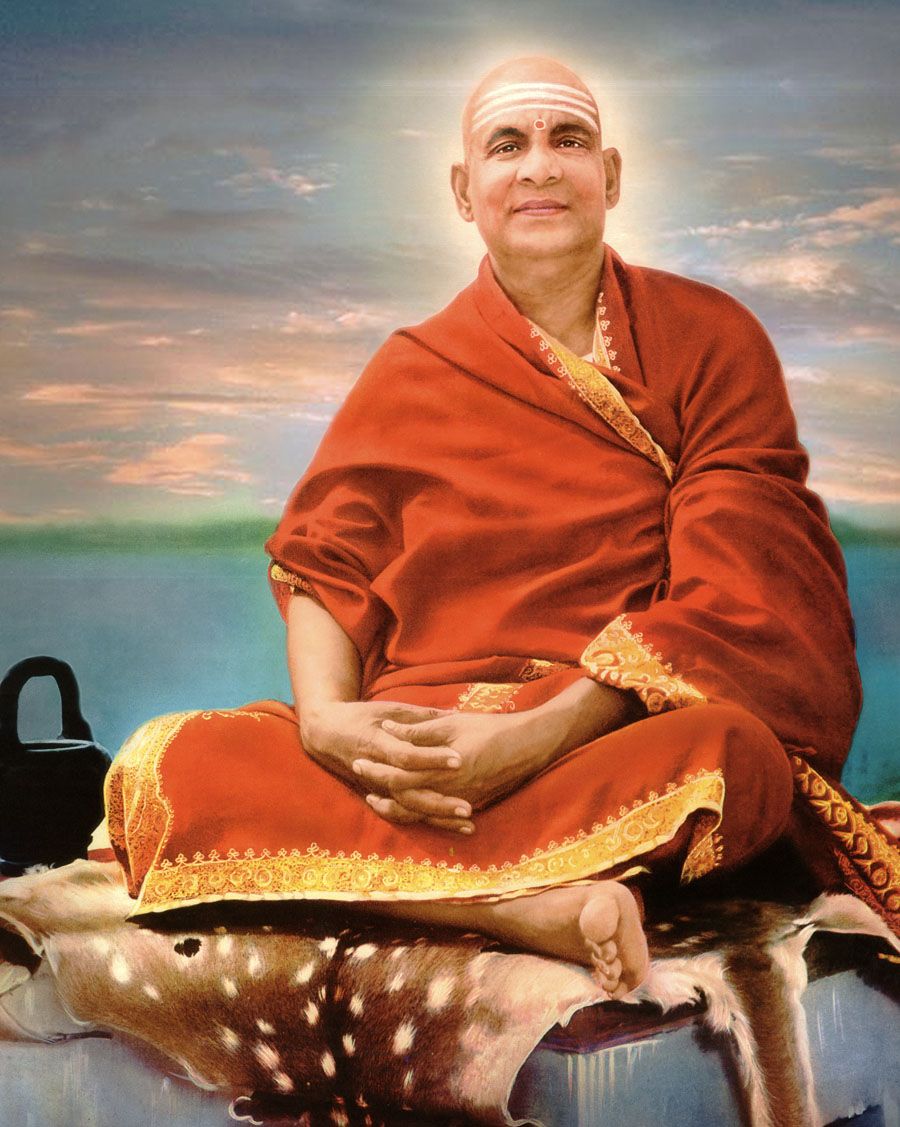


Swami Sivananda writes on “Peace”

WHAT IS PEACE?

Peace is a state of quiet. It is freedom from disturbance, anxiety, agitation, riot or violence. It is harmony, silence, calm, repose, rest. Specifically, it is the absence or cessation of war.

Peace is the very nature of the soul or Atman. All the Vrittis or modifications of the mind are dissolved in the soul. There is no Sankalpa or thought in the soul.

The peace of God fills your heart. Realize this stupendous peace of God that passeth all understanding through meditation and devotion.

Peace is a divine attribute. It is a quality of the soul. It cannot remain with greedy persons. It fills the pure heart.

Speak, move, act in peace. Peace is the happy, natural state of man. It is his birth right. War is his disgrace.

WHERE IS PEACE?

Peace is not in the heart of the carnal man. Peace is not in the hearts of ministers, advocates, businessmen, dictators, kings and emperors.

Peace is in the hearts of Yogins, sages, saints and spiritual men.

Peace is not in money, estate, bungalows and possessions. Peace does not dwell in outward things, but within the soul.

Withdraw yourself from external objects, meditate and rest in your soul; you will realize everlasting peace now.

Wealth, women, children, property and palatial buildings cannot give you everlasting peace.

Peace deserts the lustful; it runs away from selfish people. It is an ornament of a Paramahamsa.

Dear All,

If we take the first para where the sage describes “what is peace?”, He says,

“Peace is a state of quiet. It is freedom from disturbance, anxiety, agitation, riot or violence. It is harmony, silence, calm, repose, rest. Specifically, it is the absence or cessation of war.”

In simpler expression, if the author has to define peace, “Peace is the actual, real state of mind, when the play of vasanas about one’s own self and the vasanas about others is transcended”

When all impressions are uprooted, then one exists in and as one’s real nature, Swa-roopa

This state has actually no expression, but for the spiritual seekers to relate to this state in their initial days of sadhana, the state has been defined as “Peaceful state”.

Contentment is the effect, the culmination of “Peace”.

When the heart/mind is at peace (as explained by Swami Sivananda), then, the sadhaka rests in that peaceful state and there is no craving to attain anything outside him. This state is the state of contentment.


Love.


Monday, July 5, 2021

Dhyana Vahini - Post 39

Chapter XIV


Swami continues,

"About anger, spiritual aspirants have to be vigilant even about the most minor matters that might provoke them, because if they are careless, they cannot progress in the least. Such people must cultivate a humble, loving spirit. Then the bad traits will disappear. Some aspirants become very angry when someone discovers and announces to them the bad traits they possess. This makes matters worse!

Eliminate pride

Aspirants must always have the inward look; if they allow the mind to wander outward, they cannot identify their own faults. Pride prevents the inward look and confuses the examination of the mind. When aspirants want to achieve success, they must bow down to those who point out their faults. That is the way to progress quickly and fast in the path of meditation. And they must endeavor not to entertain the faults any longer.

It is hard to get rid of pride and self-love or ego (ahamkara), for everyone has been shaping this life from the beginningless period. Everyone has been allowing their mind to flow in the direction it likes for ages past, so it is very difficult now to turn it from its accustomed path and bend its steps in another direction.

Individuals full of I (aham) love to exercise authority over others. They will not agree with others that it is “bondage”, for the arguments of others are not advanced by them! They see everything through glasses coloured by the smoke of selfishness and self-love. “My words are true.” “My opinion is correct.” “My deeds are right.” Thus, they feel and thus they spend their days. Such behaviour is very harmful for spiritual aspirants. They must look forward eagerly to any helpful criticism or suggestion or advice, from whatever quarter.

Besides, aspirants must minimize all discussion and argumentation, for this breeds a spirit of rivalry and leads one on to angry reprisals and vengeful fighting. Do not struggle to earn the esteem of the world. Do not feel humiliated or angry when the world does not recognize you or your merits. Learn this first and foremost if you are an aspirant for spiritual success. Do not become happy when you are being praised; therein lies a deadly trap, which might even lead you astray and endanger your progress.

Thus, you must reform your mental traits and habits. Cultivate the habit of never causing pain to others. Try to understand others and sympathize with them and do things that will be helpful. Train yourself to take insult and criticism as “decorations” awarded to you. Struggle hard to be friendly with everyone, whatever their nature or conduct. 

A sense of joy is necessary for meditation and concentration to progress, but many things deprive you of the atmosphere of joy. So, you must pray sincerely, to be free from such obstacles. The recital or repetition of mantras will be of great help.

Introspection

There is nothing to write on today’s Dhyana Vahini post as Swami has written so clearly that anyone can understand.

Let us just take one part from today’s post where Swami Says,

“Do not struggle to earn the esteem of the world. Do not feel humiliated or angry when the world does not recognize you or your merits.”

“Do not become happy when you are being praised; therein lies a deadly trap, which might even lead you astray and endanger your progress.”

In this context, instantly, a verse from Vivekachudamani came into author’s thought, which he has quoted many times in various spiritual sessions.

This verse is about a Jivanmukhta, one who is liberated while he is alive.

This verse echoes exactly the portion taken up in today’s introspection.

It goes like this,


इष्टानिष्टार्थसम्प्राप्तौ समदर्शितयात्मनि

उभयत्राविकारित्वं जीवन्मुक्तस्य लक्षणम् ४३४

iṣṭāniṣṭārthasamprāptau samadarśitayātmani |

ubhayatrāvikāritva jīvanmuktasya lakaam ॥434


434. When things pleasant or painful present themselves, to remain unruffled in mind in both cases, through the sameness of attitude, is a characteristic of one liberated-in-life.

Describing this quality of Jivanmukhta, Swami Chinmayananda in one verse of this sacred treatise, says,

“Adorations or censures, reach His bosom and disappear from there, without creating an impact in him and there, He exists, ever rooted in consciousness ( Stitaprajna).”

So, in the context of what Swami has written, this mental attitude of not being affected by praise or abuse must be practised by a sincere seeker in the beginning and it requires deliberate efforts in the beginning. 

However, this is the very nature of the one who realizes SELF, as given in the Vivekachudamani verse.

And, towards the end of today's portion, Swami leaves a very important message for all sincere spiritual seekers. He writes,

"A sense of joy is necessary for meditation and concentration to progress, but many things deprive you of the atmosphere of joy.

Dear Seekers,

Spiritual Sadhana, as we evolve from the kindergarten stage, must be taken up with great sense of joy, great sense of motivation, great sense of exuberance.

Sadhana is never an escapism from misery, to be filled in misery and then crying out to the Lord in sadhana to remove misery.

It is precisely for this purpose that Swami advises students to take up simple bhajans giving great ananda, with expressions filled with Ananda.


Swami says, keep all your sad moods, sad bhajans to yourself and sing when you are alone. When you are in group bhajan singing, sing with joy, for, that joy would spread in the gathering very fast. 


Love.


Friday, July 2, 2021

Dhyana Vahini - Post 38


Chapter XIV


Remove Defects in Character


"But you should avoid the difficult obstacles in the path of meditation, viz. anger, pride, conceit, the tendency to discover the faults of others, mischief, etc. These operate even subconsciously, as the currents in the depths of the ocean.

Spiritual aspirants must be vigilant not to lose their temper on even small things, for that will block their progress. They must cultivate love toward all, and meekness. Then, undesirable habits will fall away from them, since anger is the parent of all wrong behaviour. Anger can turn any person into bad ways, any moment, and in any form. So it should be sublimated first by systematic effort.

Spiritual aspirants must welcome gladly the announcement of their defects by anyone; indeed, they must be grateful to those who point them out. Aspirants must never entertain hatred against them, for that is as bad as hating the “good”. The “good” has to be loved and the “bad” discarded. Remember, the “bad” should not be hated. It has to be given up, avoided. Only people who can do this can achieve progress in meditation and spiritual wisdom.

Conceit, jealousy, the passionate (rajasic) exhibition of one’s superiority, anger, the craving to inform oneself of the weakness of others and their failings, trickery —all these are obstacles in the path of meditation. Even if these are not patently exhibited, the inner impulses urging one along these wrong directions are latent in the mind.

Just as a room kept closed for a long time is found dust-ridden and foul-smelling, is opened, cleaned, and made habitable by elaborate sweeping and dusting, so the mind has to be cleaned by meditation. Spiritual aspirants must, by inward observation, examine the mind and its contents and condition. By proper disciplinary habits, the accumulated dirt should be removed little by little, systematically. 

Conceit, for example, is deep-rooted and unyielding. In the passionate (rajasic) mind, it puts forth many branches in all directions and spreads everywhere. It might appear to be dry and dead for some time, but it will sprout again, easily. As soon as a chance arises for its exhibition, it will raise its hood. So, spiritual aspirants have to be ever vigilant."


Introspection

Swami has given the following factors as obstacles in meditation

*           Conceit 

*           Jealousy 

*          The passionate (rajasic) exhibition of one’s superiority    

*          Anger 

*      The craving to inform oneself of the weakness of others and their failings

*           Trickery 

Basically, all of them and even more such obstacles, stem from one single root cause, which is Ego / avidya or ignorance of one’s true divine nature.

On conceit, a monk writes,

“Conceit (Pride) is the cause of self-destruction

Once upon a time, a horse named Keshi represented the demon of vanity. Such a big, gigantic powerful horse scattering the clouds, causing the earth to tremble he actually had the audacity to think that he can conquer Krishna himself, such vanity. 

But Krishna got him perfectly, because everyone knows, if you want to control a horse it’s through his mouth. So, Krishna knows the weakness of everyone and He put His hand right in the mouth of Keshi. 

When we are proud it is inevitable, we have to offend, criticize & defame others, which is the greatest detriment to our spiritual lives.

How to think that I am the servant of the servant of the servant of the servant even though I have so many qualifications. I am a senior devotee, I have been around for a long time, I have been loyal to my wows, so many people are coming & respecting me with folded hands?.

How can I feel myself the insignificant servant of those people who are coming & honoring me? Very difficult but it is essential. Bhakti is not material, Krishna is pleased by our state of consciousness, by our humility, by our surrender by our dedication to the service of his devotees; and that service should be from the heart.” 


Love.