Dear All,
Let us get deeper into the Atma-dharma and Para-dharma today.
Swami narrates a small story to explain what is Para-dharma.
"Lord Rama once narrated a story of his famous ancestor Sibi. once upon a time, A pigeon came frantically seeking refuge in King Sibi, saying that it is being chased by an eagle.
When the eagle arrives at the spot, Sibi warns it and asks to leave the pigeon alone.

You might claim that it is your dharma to protect one who has sought refuge under you but you are obstructing my dharma of hunting and feeding myself." This gets Sibi thinking and he offers eagle flesh from his own body, equal to the weight of that one pigeon."
Dear All,
Both Swadhamra or Atma-Dharma and Para-Dharma are clearly explained in this story narrated by Swami (Source - Message of the Lord book, Page 216)
The eagle was correct in following its Para-Dharma or Achara-Dharma or its physical Dharma based on its Body consciousness.
King Sibi did recognize eagle's Achara-Dharma but His Atma-Dharma which followed from his God consciousness illumined his sense of Self Sacrifice and Compassion and thus, he sacrificed his own flesh due to his compassion for the eagle.
Throwing more light on Para dharma is the illustration of Arjuna.
Arjuna belonged to the warrior class (kshatriya) and never renounced his soldier hood. In fact, he had come to Kurukshetra to fight, more specifically to fight against Adharma or unrighteousness of the Kauravas.
Thus, when Arjuna expresses his grief to Krishna as to how can he fight against his own brothers, his own acharya, his own grandfather etc., Krishna sings the song divine and teaches Arjuna -"Do your duty to which you are born".


Dear All,
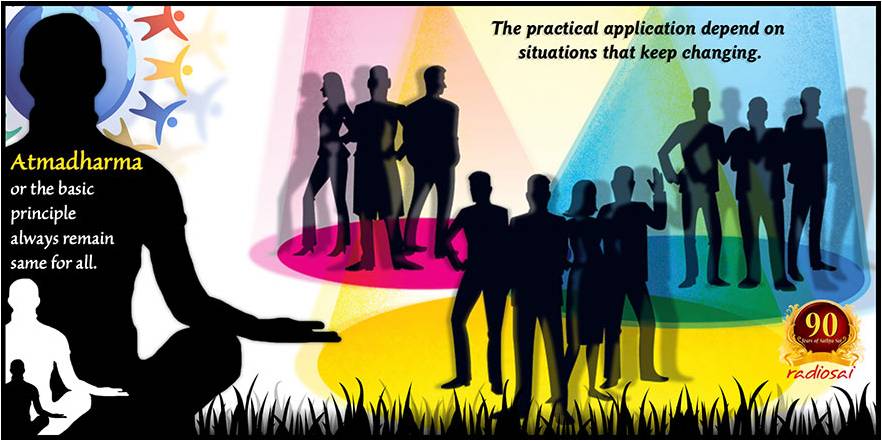
The dharma of eagle and dharma of Arjuna explained above were different. Similarly, each one of us might have different acharya-dharma, depending upon our role in the society, the job we are performing, the stage of life in which we are existing at any point of time and so on.
A lawyer, a businessman, a police man, teacher, a housewife, The PM of a nation .... depending upon what role one is performing, his para-dharma or acharya-dharma changes.
Also, talking about stage in life, a human being's dharma as a boy, then when he becomes a youth, then when he is married and becomes a father, then when he retires from his family life- his duty/ dharma changes in each stage of life even when the human is the same all the while.
However, irrespective of the Achara-Dharma/ Para-Dharma / Dharma of this body might change from time to time, from person to person, the Atma-Dharma of each and every human being remains the same, at all times.
Human being alone has the faculty of Discrimination / Buddhi and thus, using his higher intellect, human alone can practice / live / exist with his Atma-dharma (Union with God and all virtues that follow this single goal of God realization - love, Compassion, Forbearance etc.)
Prof Venkatraman sums up the topic beautifully thus:-
"Now you might say: “Hey! Wait a minute!! Swami is God and so He can do all that you say! We cannot. We are mortals, we are mere humans. We are not God; are you not forgetting that?” Well, I ask in return: “Are you, dear reader, not forgetting that Swami repeatedly tells us that we also are God, and that we must rise above the so-called human level so that the Divinity latent within us gets revealed? Has He not told us that the human form has been specially given to us so that we can follow Atmadharma and redeem our lives?”
"Now you might say: “Hey! Wait a minute!! Swami is God and so He can do all that you say! We cannot. We are mortals, we are mere humans. We are not God; are you not forgetting that?” Well, I ask in return: “Are you, dear reader, not forgetting that Swami repeatedly tells us that we also are God, and that we must rise above the so-called human level so that the Divinity latent within us gets revealed? Has He not told us that the human form has been specially given to us so that we can follow Atmadharma and redeem our lives?”

Love.


