Tuesday, November 26, 2024

Vivekachudamani- Post 60


Who else but oneself can help rid oneself of the bondage caused by  the chains of ignorance, desire, action and so on, even in a hundred crore of kalpas? (60)


The bondage felt by the mortal is caused by the ignorance of his  own real nature. This ignorance of his own all fullness in his  spiritual personality creates in his intellect, waves of desires with  which he expects to make himself full. Desires create thought  waves in his mind, and thoughts express themselves as action. 


These three - ignorance, desire and action - are together called  in Vedanta sastra as the "heart knots' (hrdaya granthi). These are  the cords that bind the ego (jiva) to the finitude and sorrows of a  mortal. 


What is avidya? ignorance; ignorance of what? In vedantic context, ignorance means ignorance of my own real nature. Ātma avidya ityarthaḥ;

And what is the next strand? kama, which is the consequence. How does avidya cause kama? Kama means desire; so my real nature is purnatvam; fullness. And if I am ignorant of my fullness; I am going to mistake myself as incomplete.

And once I have concluded that I am incomplete, then what happens? I have to struggle to make myself complete.

And this struggle for completion is called kamah; and the kama leads to varieties of karma;

In this enumeration of ignorance, desire and action when  Sankara adds 'and the like' he means, the residual impressions  (vasanas) that are left on the mind when a desire prompted activity  is consciously undertaken. These vasanas thicken the ignorance  by darkening desires, agitating thoughts and propelling us into a world of frenzied activity. 

The Acharya, naturally asks, who can save a man from the  chaos in his mind and intellect which is responsible for his rabid activities in the world of objects and his painful confusions in his  relationships with his fellow beings? The answer is contained in  the question itself; none but he himself. 

Guru also can give assistance by teaching. Sastra also can assist the guru kripa can help; sastra kripa can also help; even Isvara kripa can only give assistance; but none of them can replace our Will or effort and therefore our freewill has to be appropriately used.

Sankara  asks; Atmanam vina kaha bandam vimochitum saknuyad. Who can remove the bondage? So who can throw away the bondage; remove the shackles; atmana vina; other than oneself. 

Even God cannot remove my bondage, guru cannot remove my bondage, sastra cannot remove one’s  bondage, if one  try to removes; if one works for the removal, they can all assist him.

The term 'kalpa' is used to indicate the entire duration of one  universe from its day of creation to the day of doom. It has been calculated that the life of the universe is one day of the Creator  which is equivalent to 432 million years, in terms of calculation of time, possible with our finite and limited time.

Love


Friday, November 22, 2024

Vivekachudamani-Post 59

The actuality of things is to be known by a first-hand personal experience through the eye of clear understanding and not through the  report of learned men. The beauty of the moon is enjoyed through one's own eyes; can one appreciate it through the description by others? 


Sankara reinforces the idea in the above three examples with yet  another verse, hammering, as it were, the last nail on the coffin  of our doubts. 

The beauty, the brilliance, the soft glory, the queenly  dignity, the serene consolation, the message of love and leisure, of peace and quietude, which the moon sheds as it glides across  the springtime skies cannot, indeed, be captured in words but they  are experiences to be enjoyed subjectively only. 

The vision of its  majesty is to be perceived by one's own eyes and experienced in  satisfying suggestive silence. A blind man cannot enjoy the love  messages of a moonlit night. 

When the Self rises in the dark bosom of our ignorance and glides across the horizon of our experiences, that experience  cannot be described fully by us to another, even though he may  have experienced it himself. Each must experience it for himself, in himself. This analogy of moonrise is indeed the most poetic and by far the most appropriate example to indicate the soft silvery light  of knowledge that illumines, with its sublime peace and perfection,  the dark atmosphere in the bosom of the ignorant.

vasthu svarupam, vasthu means reality. The ultimate truth is called vasthu. So in Samskrit the word vasthu has got two meanings; one meaning is any object in the world is called vasthu.

But in the context of vedanta; the word vasthu has a specific meaning and this is paramarthika satyam; the absolute reality. And the corresponding opposite avasthu means mithya or unreal.

It is derived from the word  “vas”, to exist. 

vasathi; asthi, sarvadha asthi ithi vasthu; that which exists eternally. That which is unnegatable is called vasthu; in short satyam. So vasthu svarupam means the nature of reality 

svenaiva vedyam has to be known by oneself. The nature of reality has to be known by oneself through what means? 

Sputa bodhacaksusa; through the eyes of clear understanding; through the eyes of clear understanding; bodhah means jnanam, sputa bodhaḥ means clear jnanam, caksusa means eye; jnana caksusa  vedyam.

Many people think that there is a physical eye in the forehead and they try to open it; some people call it ajna chakram; and even ajna chakram is symbolic; there is no such thing called a physical or subtle eye; if at all you call it subtle eye it should be understood as antha karanam. 


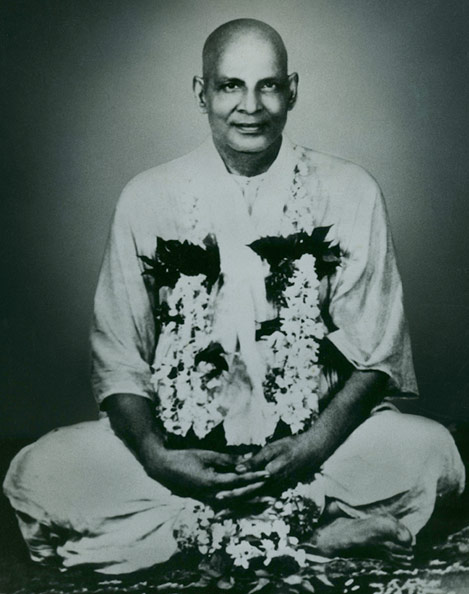
Swami Sivananda writes on Grace (of Guru) and Self Effort.


SiteFiles/photos/

Realization cannot come to you as a miracle done by your Guru.  Lord Buddha, Lord Jesus, Rama Tirtha have all done Sadhana. Lord Krishna asks Arjuna to develop Vairagya (dispassion) and Abhyasa (practice). 

He did not say to him, “I will give you Mukti(liberation) now”. Therefore, abandon the wrong notion that your Guru will give you Samadhi and Mukti. Strive, purify, meditate, and realize.


Guru-kripa-grace of a Guru-is very necessary. That does not mean that the disciple should sit idle. He must do rigid Purushartha, spiritual practices. The whole work must be done by the student. 

The Guru and the Shastras can show you the path and remove your doubts. Anubhava (direct experience) of the Aparoksha kind or direct intuitive knowledge is left for your own experience. A hungry man will have to eat for himself. He who has a severe itching will have to scratch for himself.

No doubt, the Guru’s blessing can do everything. But how can one have his blessings? By pleasing the Guru. A Guru can be pleased with his disciple only if the latter carries out his spiritual instructions implicitly. 

Carefully follow, therefore the instructions of the Guru. Act up to his instructions. Then only will you deserve his blessings, and then alone his blessings can do everything.”

Love


Tuesday, November 19, 2024

vivekachudamani-Post 58

51. A father has his sons and others to save him from his financial debts , but to redeem himself from his delusions , he has to resort to  none but himself.


52. Exhaustion and fatigue caused by carrying a load on the head can be  relieved by others coming to one's help. But none , save one's own self  can end the pangs caused by hunger and so on. 


53. The patient who faithfully follows the right diet and takes the proper  medicine alone is perceived to recover from his illness; no one recovers  because another undergoes the treatment. 


Since Chinmaya has dealt with the three verses together, the previous verse is also referred here again, though there was a detailed commentary on the same in the previous post.


Chinmaya writes,


“In these three verses, the Master is trying to drive home the  importance of self effort upon the student. Any amount of hearing, study, intellectual thinking and logical discussion cannot by themselves bring about Liberation from our misconceptions and  false evaluations in life. 


In order to impress this idea upon the student, the Teacher  gives three verses with three different examples. These homely analogies which fall within the experience of everyone are given  to remove any possible misunderstanding of the student regarding  the technique of Self-realization. 

All the objective sciences in the world can be mastered by merely studying them. The man who studies the law of the country  with all its implications can become a lawyer; he who studies the  symptoms of diseases and their cures can become a doctor. 

An advocate of criminal law need not be a criminal himself, a doctor  need not himself be a patient to know the science of medicine. 


But Atma-vidya is gained only when it has brought about a  complete regeneration of the individual who studies it. After gaining the objective knowledge there must also be a subjective achievement. 


Let us see the 3rd verse quoted in today's post, verse no 53.

The Teacher, not satisfied with these two striking examples, adds yet another verse to drive home to the student the necessity  for conscious personal effort. He says, 'Only those patients are cured of their ailments who faithfully follow the prescribed diet and take the right medicines themselves.' 


To come back to your natural healthy condition; which means removal of the unnatural condition; your sadhana is two-fold. What are the two sadhanas? 

Medicine taking is the main one to cure the disease, but as important as medicine is the pathyam (this a Tamil word) which means the discipline/diet we must observe, the Do’s and Don’ts we have to follow. 

Without pathyam , medicine is useless and there is another person who observes all the pathyam, but he does not take medicine. Then also it will not work. Therefore which is important if somebody asks, I should answer both are equally important. Both are equally important.

For getting moksha  also, two things are there; pathyam and oushada seva. 


Medicine in the context of Sadhana

Vedanta Sravaṇa Manana Nidhidhyasana, is the medicine. Without the study of scriptures moksha is never possible; whether the scriptural study is for long time or short time; that all depends upon the condition of sickness. 

But at the same time, sastra warns that any amount of  sravaṇa manana nidhidhyasanam you may do, it will not give you any benefit, unless you follow the pathyam also. Without the pathyam, all your study will make you a wonderful scholar. 

Pathyam in the context of Sadhana

Sadhana chatuṣṭaya sampatti is the pathyam.

What is the level of viveka? What is the level of vairagya? What is the level of sama, dama, uparama, titiksha  and finally and most importantly what is the level of mumukshatva?

It is observed by the author that even after decades of sadhana, few sadhakas are  unable to get closer to Self Realization. 

The problem is in their pathyam- Sadhana chatushtaya

Somewhere they are lacking in viveka or vairagya. Without viveka, vairagya, mumumkshatva is impossible and without 100% tivra Mumukshatva, even after 10/20 years of sadhana, one can be pulled by Samasara, by the objective world, by relations, by attachment and the sadhaka is pulled down to zero level in their sadhana/ in their purpose of God realization.


Coming back to the three examples, Sankara  has chosen such examples, that we are not acquiring anything new. We are only removing something. So therefore, hunger and thirst problem he has given. Here also our aim is what? removing the hunger and thirst and upon their removal,  health is the natural condition of a person. We never acquire health. 

Similarly, samsara   is unnatural; or struggle is only to remove the unnatural samsara and once the unnatural samsara  is removed; liberation is not acquired; you come back to your natural state of liberation.


In short, each one of us must walk the path by himself but properly guided by the instruction of the Teacher and the scriptures. 

Love