Monday, June 23, 2025

Vivekachudamani-Post 82


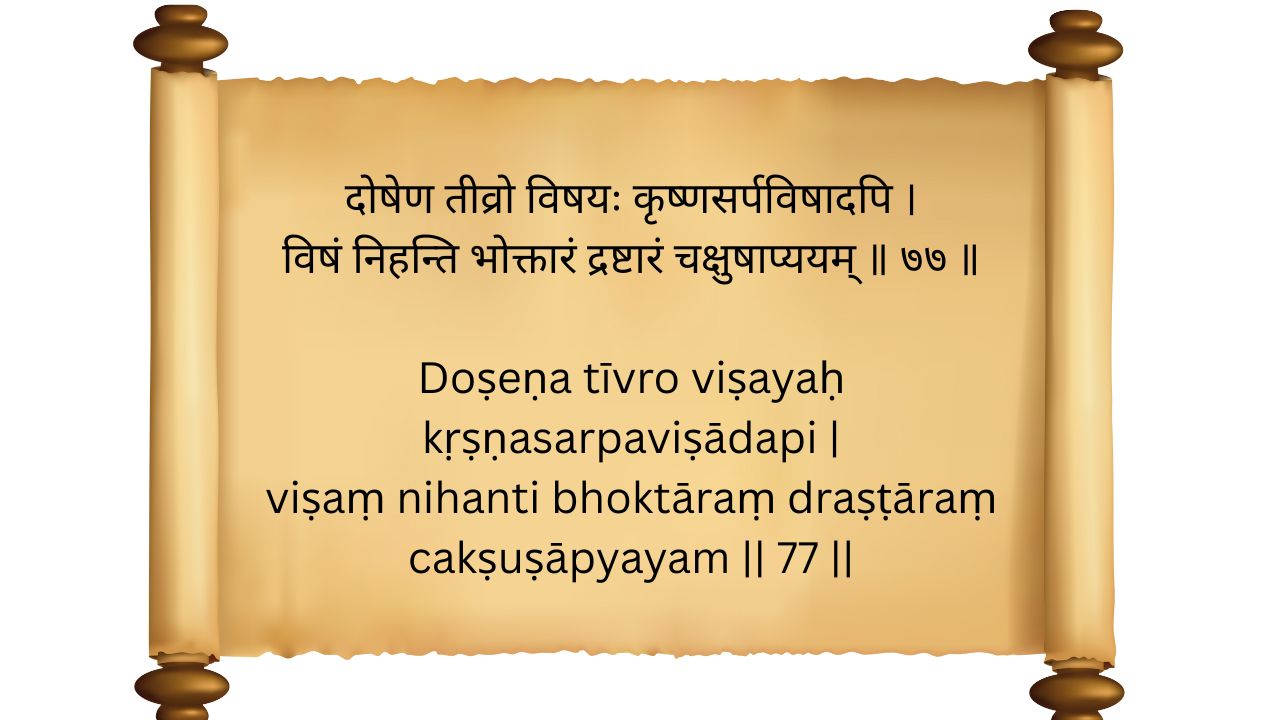
Sense objects are even more venomous in their tragic effects than cobra poison. Poison is fatal to one who swallows it, but the sense objects  kill him who even looks at them with his eyes. (77)

At this juncture, Sankara discusses how dangerous it is for a seeker to be attached to the enjoyment of sense objects. 

In order to emphasize  the virulence of sense poison, Sankara gives yet another verse,  which is very famous, in as much as, we often hear it being quoted from all pulpits. 

Explaining the dangerous intensity of this poison, the Acharya compares it with the venom of the cobra. 

Vishayaḥ dosena tivraḥa; in terms of his harming capacity; pulling down capacity; the viṣaya is tivrah; more intense; more powerful than vishadapi; even poison. That too what type of poison? 

Krishna sarpa; the black cobra; Krishna here means black or dark ones; the black cobra visham; and the viṣaya is more harmful than that.

How does Sankara say so? To give a logical proof also; he gives the logical proof; what is that; visham boktharam eva hanthi;

Poison will kill only a person who consumes the poison. By hearing about or by seeing, the poison does not kill; only when it enters the system and is absorbed in the system; only then it will kill. 

Therefore boktharam vishaṁ hanti; whereas what about viṣaya; cakṣuṣa drastaram hanti; even that person who sees the viṣayaḥ.

If there is some distance between a cobra and an individual, the poison in  the cobra cannot affect him. Nobody is known to have died of poison because he merely saw a cobra in a zoo. 

The venom can be fatal to a person only when he is bitten by a cobra. Compared with this, sense objects are more virulent because they can annihilate the individual who just looks at them. 

The organ of vision mentioned in the verse, represents all the other four sense organs and indicates a similar end when all other sense  organs, individually or collectively, run after their sense objects, bringing about a total annihilation.

So here what is the idea conveyed? That if a person does not have a discriminative power; then the very sight can cause attachment; and then he goes on thinking about that

In the  second chapter of Bhagwad Gita, Krishna says,

While contemplating on the objects of the senses, one develops attachment to them. Attachment leads to desire, and from desire arises anger.(2-62)

Anger leads to clouding of judgment, which results in bewilderment of memory. When memory is bewildered, the intellect gets destroyed; and when the intellect is destroyed, one is ruined.(63)

Most intelligent and moral personal can drop all the ethics and morality and go to adharma and once dharma goes away, moksha is farther. 

And for that viṣaya dhyānam, what is the cause? Vishaya darsanam is the cause for viṣaya dhyanam. Viṣaya dhyanam is the cause of spiritual death.

A person should be careful with regard to the external world, until he learns to manage his rāga dveshṣa; which is called samaḥ; learning to manage raga-dveṣa is sama.

once the mind is mastered, then whatever the sense organs perceived; no problem; but because he knows what is attachment and what is freedom from that. 

Love


Wednesday, May 28, 2025

Vivekachudamani-Post 81


The deer, the elephant, the moth, the fish and the honeybee - these five are annihilated because of their slavery to one or the other of the senses such as sound and so on, through their own attachment. What then is the condition of a man who is attached to all these five? (76)


We are now discussing how attachment to the senses bind, enslave and destroy the peace of mind and freedom of true living. At this moment Sankara very appropriately, reminds us of the various examples provided by nature where certain species meet their death due to extreme attachment to one or the other of the five senses. 


The deer is always fascinated by melodious sound and the deer hunter sings to charm the deer. Attracted by the melody of sound, the deer has no awareness of the danger it is in and turns in the direction of the music, the hunter soon makes it his target. Therefore kuranga stands for sabda asa.


The elephants, especially in the mating season, become extremely attached to the sense of touch, rubbing against each other and walking without caution, they fall into the pits got ready to  catch them.  Therefore, elephant stands for sparsa asa, weakness for skin.


The moth is enchanted by form and attracted by the brilliance of the flame. It flutters towards it with an agonizing impatience and gets burnt. What we are taking advantage of is its weakness for bright light/lamp. Therefore rupa asa or rupa ragah.


The fish, ravenously hungry at all times, in its gluttony, swallows the bait, is caught and thus meets  its end in the stomach of fish-eaters. And therefore, minam has got rasa asa, or rasa ragaḥ. 


And then finally bhr̥ngaḥ vandu, the honey bee;  it t is attracted by the smell of the flowers; and because of that it is captured by certain flowers; it closes during the night; when it is attracted, especially in the evening time; goes and sits there; and the flower closes and it gets trapped and the commentator says, 

Again we do not know, we have to verify; that certain strong smell, like the smell of champaka flower that is so strong; that the bee will die because of the intensity of the smell; that the smell itself directly destroys that insect. Again, it has got what? gandha asa or gandah raga.


And therefore, each one of these animals dies because of its bondage caused by one guna; sabda guna; sparsa guna; rupa guna; rasa guna or gandha guna; that is said in the first line. pancha pancatvamapuh; 


Pancha means these five animals; so these above mentioned five animals; pancatvamapuḥ; gets destroyed; they perish; because of what? svagunena baddhaḥ; and bound by their own weakness for one one guna only. 

Now come to the fourth line, panchabhirancitaḥ kim; what to talk of the human being who has got all the five weakness? So ancitaḥ, ancitaḥ means associated with the panja asas. The five-fold attachment.

And this is not his mistake. Remember, this is not his mistake; these are all five natural instinctive weaknesses. So we have this weakness we need not feel guilty about their presence; the arrival is not because of it; it is instinctive. We are to be blamed if we are going to keep that weakness going. So therefore, perpetuation of the weakness is the mistake; the presence of the weakness is not our mistake.

If the weakness is there; we need not feel guilty; but we allow them to continue; we have to feel the guilt. Therefore, the presence is not weakness; perpetuation is the weakness. More in the next class.


When a man of ignorance, having neither discrimination nor detachment, vulgarly runs after sense objects for his temporary nerve tickling, he becomes a sad victim of his delusion and meets a calamitous end for he has allowed himself to be bound by the five strong ropes.


Love


Friday, May 23, 2025

Vivekachudamani- Post 80


Having united with parts of one other, they become gross and become the cause for the formation of the gross body. Their subtle essence constitutes the sense objects, five in number such as sound and so on, which contribute to the enjoyment of the experiencer, the individual ego.(74)

Tanmatra/ Panchikarana etc. are adequately described in the posts under the theme Tatwa Bodha. Readers are requested to go through the relevant posts in Tatwa Bodha for better understanding of  these terms.


75. Those thoughtless ones who are bound to these sense objects by the stout ropes of attachment, so very difficult to cut asunder, come and go, carried up and down by the compelling force of the convoy of the reactions of their own past actions. 


A samsarin is under the persecution of sense objects  because of his attachment to them. These attachments are so strong  that they become almost unbreakable. Thus bound to the gross, the ego ekes out its experiences and yearns for more. 


Every moment, it perpetrates endless activities each providing its own reactions to be enjoyed or suffered by the same ego. Thus repeatedly, the same ego visits different fields of activities and in a variety of environments. 

It again and again enters and leaves the arena of existence, reaping its reaction and sowing new seeds through desire prompted activities, which in their turn, compel it to come again to reap the fruits of the new harvest. 


Sankara says mudah; majority of humanity is mudah. So totally deluded; they think their physical body themselves; this is the first attachment. This is to their own physical body; by which they become a physicalized personality. 

Even their emotional and intellectual personality are forgotten; they reduce themselves to a physical personality; and through this physical attachment; it is extended to all other attachments.


Attachment to my body is called ahamkara; attachment to the world is called mamakara. Ahamkara mamakara moha, makes a person mudah; 

ya esu mudha viṣayesu baddha; they have lost their freedom; they are imprisoned by various sense objects.


When the reactions of the past actions tend neither towards  too much enjoyment nor too much suffering, that is, they are  almost equibalanced, then such an egocentre, with its slightly  predominant tendencies to be either good or bad, presents itself  in a human form. 


Thus a chance is given to everyone to consciously move either  up or down, or towards the infinite freedom of pure godhood.  Spiritual endeavour however, is possible neither in the heavenly  planes of experiences indicated by the term 'up' nor in the fields of sorrows covered by the term 'down'. 


Each of us comes to gain the required field, appropriate  and forming a perfectly logical sequence with the motives, thoughts  and desires entertained in the past. Guided by the very instincts  created in us as a result of our past karmas, that is, ordered by our  own karmaduta, we reach our destinations sought by ourselves. They are nothing but frozen past intentions now beginning to thaw.

Love