Thursday, November 21, 2019

Bhagwad Gita - Post 119


Verse 4

Buddhir jnaanamasammohah
Kshamaa satyam damah shamah;
Sukham duhkham bhavo’bhaavo
Bhayam chaabhayameva cha.

Intellect, wisdom, non-delusion, forgiveness, truth, self-restraint, calmness, happiness, pain, birth or existence, death or non-existence, fear and also fearlessness,

Verse 5 

Ahimsaa samataa tushtistapo
Daanam yasho’yashah;
Bhavanti bhaavaa bhootaanaam
Matta eva prithagvidhaah.

Non-injury, equanimity, contentment, austerity, fame, beneficence, ill-fame—(these)different kinds of qualities of beings arise from Me alone.

Verse 6

Maharshayah sapta poorve
Chatwaaro manavastathaa;
Madbhaavaa maanasaa jaataa
Yeshaam loka imaah prajaah.

The seven great sages, the ancient four and also the Manus, possessed of powers like Me (on account of their minds being fixed on Me), were born of (My) mind; from them are these creatures born in this world.

Dear All,

Before proceeding with the commentary on the above verses  and in fact for all the verses of this chapter, it is worthwhile to refresh ourselves with the following extract taken from a previous theme post.

Three questions were put forth by the author on behalf of the readers / aspirants, in  a post under "Creation of the Universe” theme. 

1.    What is the God existence to be realized by a Jiva as culmination of Sadhana?

2.  Does God exist in universe after creating universe??

3.  What is God consciousness or Brahman actually???

In the above questions, the second question is most relevant, as this chapter is all about God existing in each and every aspect created by Him / That.


And, the answer was given, which in itself is the essence of vedanta.

"The Isavasya Upanishad says that the whole Universe is pervaded by Iswara or God, who is both within and without it. He is the moving and the unmoving, He is far and near, He is within all these and without all these."


Now, let us devote time in reading and then absorbing the same in early morning hours, in total silence, with pure mind, on one portion of the above expression "WITHIN"!!

Author is recapitulating the following part from a post under the theme "Creation of Universe".

"Suppose there is a big boulder, a stone. You see the stone; it
is very hard and heavy, and you can touch it as a solid object. 

Bring a sufficiently powerful microscope and look at this stone. You will find that the stone is a heap of very minute, fly-like, insect-like entities called molecules. It is a heap of certain things, and not one solid object.

Bring another, more powerful microscope, more powerful than the earlier one. Even the molecules will not be seen there. There will be still finer elements looking like almost non-cognizable particles which are called atoms.

Bring a still more powerful microscope. You will find that even these little particles melt into a continuum of energy, or force, which impinges on the energy center which are other atoms. It looks as if there is one sea of force everywhere, an indistinguishable continuum.

What has happened to the stone?

Can you say that this sea of force, these atoms, one day thought: “Let us become a stone”? 

If the atoms have really become the stone, they will not be there for you to see through the microscope. 

These so-called ‘things’ – molecules, atoms, energy centre  etc. – never became the stone. They were never transformed into the stone. They did not create the stone. They exist and have always existed in the same condition as they were when you perceived them through a powerful perception.

----------------------------------<>-----------------------------------

Dear All, 

What do we learn from the above profound revelation??

If we take the STONE referred in the above answer as equal to each and every living and non-living part created in this creation, then God is present as the “CONTINUUM OF ENERGY” explained in the above answer.

A Jivanmukhta is the one who realizes and experiences intuitively the “CONTINUUM OF ENERGY” within him and in this entire creation which is THE ATMAN. 


With this grand revelation, we will understand that in this entire chapter, Krishna means “the presence of continuum of energy” or “the SELF”  in each and everything mentioned in various verses . 

Love.
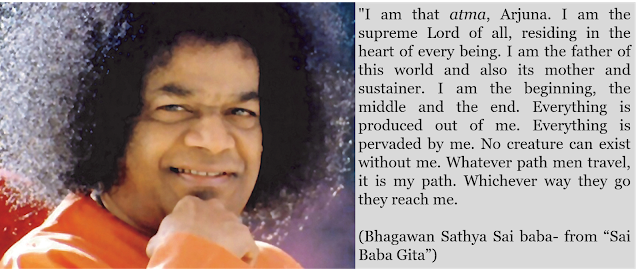

Tuesday, November 19, 2019

Bhagwad Gita - Post 118

Verse 3

Yo maamajamanaadim cha
Vetti lokamaheshwaram;
Asammoodhah sa martyeshu
Sarvapaapaih pramuchyate.

He who knows Me as unborn and beginningless, as the great Lord of the worlds, he, among mortals, is undeluded; he is liberated from all sins.


THE LORD OF ALL THE WORLDS (SARVA-LOKAMAHESHWARAH)

'Loka' comes from a root meaning 'to experience', and therefore, the world should, in its full import, mean 'a field for experiencing'. Usually, it is mistaken as the "field of experiences" that one revels in at all levels of one’s  body, my mind and my intellect.

In reality, Pure Awareness or Consciousness, without which we are dead to the world, with which we  perceive the world and live in it actively, should necessarily be the Presiding Chieftain that rules with His Grace, our  'loka'. 

To make the distinction between the Souls and Himself, Shree Krishna declares that He is loka maheśhwaram (the great Lord of all the abodes of existence). The same declaration has been made in the Śhwetāśhvatara Upanihad:

Tamīśhwarāā parama maheśhwara
Ta devatānā parama cha daivata
Pati patīnā parama parastād
Vidāma deva bhuvaneśhmīyam (6.7)[v3]

“The Supreme Lord is the Controller of all controllers; he is the God of all gods. He is the Beloved of all beloveds; he is the Ruler of the world, and beyond the material energy.”


The Self being the same everywhere, the Atman that rules my world is the Atman that rules the worlds of all individuals. The entire universe is the sum total of the worlds of experience of each individual, and evidently, the 'ruler' that governs the entire Universe must necessarily be the Absolute Self Itself. 

HE WHO KNOWS ME AS BIRTHLESS, BEGINNINGLESS AND AS THE GREAT LORD OF THE WORLDS.

A major session was  taken few months earlier on the following  verse from Taittriya Upanishad

Om Brahmavid aapnoti param  
Tad eshabhyukta
Satyam Jnanam Anantam Brahma
Yo veda nihitam guhayaam parame vyoman
Sa ashnute sarvaan kamaan  
Saha brahmana vipaschiti iti

OM. The knower of brahman attains the supreme.  with reference to that, there is this following hymn stated.

Brahman is truth (Sathyam), knowledge ( Jnanam) & infinity ( Anantam).

He who knows that it exists in the cave of the heart,  in the transcendent akasa, realizes all his desires, along with omniscient brahman.

In this session, while explaining SATHYAM or SATH, Six levels  were explained.

First Level: Astitha Maatram – “Existence alone”. This is where we began with the definition of the term Sat. 

Second Level: Guna Rahitam – “without any properties”. Being Pure Existence the implication is it is not an object and so it cannot have any properties. 

Third Level: Indriya Agocharam – “not graspable by the senses”. Since it is not an object, it is something that cannot be perceived by the senses. 

Fourth Level: Sarva Gatam – “present in everything”. If it is not within the range of our senses, then it has to be something that pervades everything, i.e. it has to be Infinite in nature. 

Fifth Level: Ekam – “One”. If it is all-pervading and infinite, then logically it has to be one whole, that is omnipresent. 

Sixth Level: Advaitam  – “without a second”. There can only be one Infinite. This understanding  rules out the possibility of there being anything else other than the pure, unborn, changeless SATH. So there cannot be another existence, SATH 2.!!! 

Without a steady, spotless screen behind the everchanging play of lights and shades, there cannot be a thrilling play.

Without a permanent and motionless bed, the water in a river cannot maintain their endless flow.

Without the solid and inert rails, the flying wheels of a train cannot move on.

Such screen / Bed / Rail - they are changeless, eternal TRUTH / EXISTENCE. 

A clod of earth or clay takes many shapes, jar, pot, lid and so on. All these changes are unreal or apparent, but the real nature i.e., clay-ness does not change. Clay is true and all the changed forms are untrue.  Gold is true but the variegated shapes it takes are untrue with respect the real nature of gold. In philosophy, one has to have the approach of a gold smith or a potter, but not that of the consumer.  

The moment we understand and live in the realization that the Self is unborn and beginning less, and that It is not concerned with decaying and perishable matter, we have gained all that has to be gained, and known all that has to be known. Such an individual of True Realization becomes himself the “Lord-of-the worlds”.


Love.


Sunday, November 17, 2019

Bhagwad Gita - Post 117


Verse 29

Anantashchaasmi naagaanaam
Varuno yaadasaamaham;
Pitreenaamaryamaa chaasmi
Yamah samyamataamaham.

I am Ananta among the Nagas; I am Varuna among water-Deities; Aryaman among the manes I am; I am Yama among the governors.

Verse 30

Prahlaadashchaasmi daityaanaam
Kaalah kalayataamaham;
Mrigaanaam cha mrigendro’ham
Vainateyashcha pakshinaam.

And, I am Prahlad among the demons; among the reckoners I am time; among beasts I am their king, the lion; and Garuda among birds.

Verse 31

Pavanah pavataamasmi
Raamah shastrabhritaamaham;
Jhashaanaam makarashchaasmi
Srotasaamasmi jaahnavee.

Among the purifiers (or the speeders) I am the wind; Rama among the warriors am I; among the fishes I am the shark; among the streams I am the Ganga.

Verse 32

Sargaanaamaadirantashcha
Madhyam chaivaaham arjuna;
Adhyaatmavidyaa vidyaanaam
Vaadah pravadataamaham.

Among creations I am the beginning, the middle and also the end, O Arjuna! Among the sciences I am the science of the Self; and I am logic among controversialists.

Verse 33

Aksharaanaamakaaro’smi
Dwandwah saamaasikasya cha;
Ahamevaakshayah kaalo
Dhaataaham vishwatomukhah.

Among the letters of the alphabet, the letter “A” I am, and the dual among the compounds. I am verily the inexhaustible or everlasting time; I am the dispenser (of the fruits of actions), having faces in all directions.

Verse 34

Mrityuh sarvaharashchaaham
Udbhavashcha bhavishyataam;
Keertih shreervaakcha naareenaam Smritirmedhaadhritih kshamaa.

And I am all-devouring death, and prosperity of those who are to be prosperous; among feminine qualities (I am) fame, prosperity, speech, memory, intelligence, firmness and forgiveness.

Verse 35

Brihatsaama tathaa saamnaam
Gaayatree cchandasaamaham;
Maasaanaam maargasheersho’
Hamritoonaam kusumaakarah.

Among the hymns also I am the Brihatsaman; among metres Gayatri am I; among the months I am Margasirsa; among seasons (I am) the flowery season.

Verse 36

Dyootam cchalayataamasmi 
Tejastejaswinaamaham;
Jayo’smi vyavasaayo’smi
Sattwam sattwavataamaham.

I am the gambling of the fraudulent; I am the splendour of the splendid; I am victory; I am determination (of those who are determined); I am the goodness of the good.

Verse 37

Vrishneenaam vaasudevo’smi
Paandavaanaam dhananjayah;
Muneenaamapyaham vyaasah
Kaveenaamushanaa kavih.

Among Vrishnis I am Vasudeva; among the Pandavas I am Arjuna; among sages I am Vyasa; among poets I am Usana, the poet.

Verse 38

Dando damayataamasmi
Neetirasmi jigeeshataam;
Maunam chaivaasmi guhyaanaam
Jnaanam jnaanavataamaham.

Among the punishers I am the sceptre; among those who seek victory I am statesmanship; and also among secrets I am silence; knowledge among knowers I am.

Verse 39

Yachchaapi sarvabhootaanaam
Beejam tadahamarjuna;
Na tadasti vinaa yatsyaanmayaa
Bhootam charaacharam.

And whatever is the seed of all beings, that also am I, O Arjuna! There is no being, whether moving or unmoving, that can exist without Me.

Verse 40

Naanto’sti mama divyaanaam
Vibhooteenaam parantapa;
Esha tooddeshatah prokto
Vibhootervistaro mayaa.

There is no end to My divine glories, O Arjuna, but this is a brief statement by Me of the particulars of My divine glories!

Verse 41

Yadyad vibhootimat sattwam
Shreemadoorjitameva vaa;
Tattadevaavagaccha twam
Mama tejom’shasambhavam.

Whatever being there is that is glorious, prosperous or powerful, that know thou to be a manifestation of a part of My splendour.

Verse 42

Athavaa bahunaitena kim
Jnaatena tavaarjuna;
Vishtabhyaahamidam
Kritsnamekaamshena sthito jagat.

But of what avail to thee is the knowledge of all these details, O Arjuna? I exist, supporting this whole world by one part of Myself.


Hari Om Tat Sat

Iti Srimad Bhagavadgeetaasoopanishatsu Brahmavidyaayaam Yogashaastre
Sri Krishnaarjunasamvaade
Vibhootiyogo Naama Dashamo’dhyaayah

Thus in the Upanishads of the glorious Bhagavad Gita, the science of the Eternal, the scripture of Yoga, the dialogue between Sri Krishna and Arjuna, ends the tenth discourse.

Love.